
Benefits
Eliminate manual data entry by converting every incoming invoice into structured records, reducing processing time from minutes to seconds.
Handle the full range of invoice layouts and formats, native PDFs, scanned PDFs, JPEG photos, and PNG attachments, with no template configuration required.
Reduce payment delays and late fees by extracting due dates and payment terms accurately, so your accounts payable team knows exactly when each bill is due.
Keep your ERP or accounting system populated with clean invoice data through workflow automation tools such as n8n, Zapier, or Make, with no manual export step.
How it works
- Step 1
Upload
Send the document to the API as a file or a URL no special formatting required.
- Step 2
The engine reads the document
The engine analyzes the page layout and identifies the content that matters. ByteIt's engine reads the full invoice layout, identifying vendor and customer blocks, line-item tables, tax breakdowns, and payment details from any section or ordering of the document, without relying on fixed-position templates.
- Step 3
Structured JSON is returned
Every extracted element comes back as structured JSON, positioned and typed, ready to feed into downstream systems.
- Step 4
Confidence-based review
Each field carries a confidence score, so low-confidence results can be routed for human review instead of trusted blindly.
Extractable fields
Features
Extracts key fields including invoice number, issue date, due date, vendor name and address, customer data, total amount, VAT number, VAT amount, VAT percentage, and IBAN or bank account number.
Extracts full line-item tables from invoices, description, quantity, unit price, and total price per line, regardless of table layout or column order.
Supports native PDF text extraction and OCR for scanned invoices and images, so you can process both digital and paper-originated documents through a single endpoint.
Returns structured JSON output with labelled fields, ready to be mapped into downstream systems without post-processing.
Accepts PDF, JPG, and PNG file formats via a simple REST API call or through interactive upload.
Use cases
Accounts payable automation
Receive invoices by email, have ByteIt extract every field automatically, and pass the structured data directly into your accounts payable workflow. Your team can approve payments faster without touching paper or rekeying numbers.
Two-way and three-way matching for purchase orders
Extract invoice number, vendor name, line items, and totals and cross-reference them against purchase orders and goods-received notes. Matching becomes automatic, exceptions surface immediately, and the approval cycle accelerates.
VAT and tax compliance reporting
Pull VAT numbers, VAT amounts, and VAT percentages from every incoming invoice. Aggregate the data per period for VAT returns and Intrastat reporting, reducing the manual reconciliation effort during tax season.
ERP and accounting software integration
Connect invoice extraction results to your ERP or accounting software using workflow automation tools like n8n, Zapier, or Make. Route approved invoices into your general ledger without building a custom integration for every system.
Multi-entity invoice processing for finance teams
Centralise invoice processing across subsidiaries by routing all invoices, regardless of vendor format or country, through a single extraction endpoint. Each entity's data remains clean and separable by customer name or VAT number.
LIVE DEMO
Test invoice extraction live
Upload one of our sample invoices or your own PDF, JPG, or PNG file to see which fields ByteIt returns and how the structured output looks.
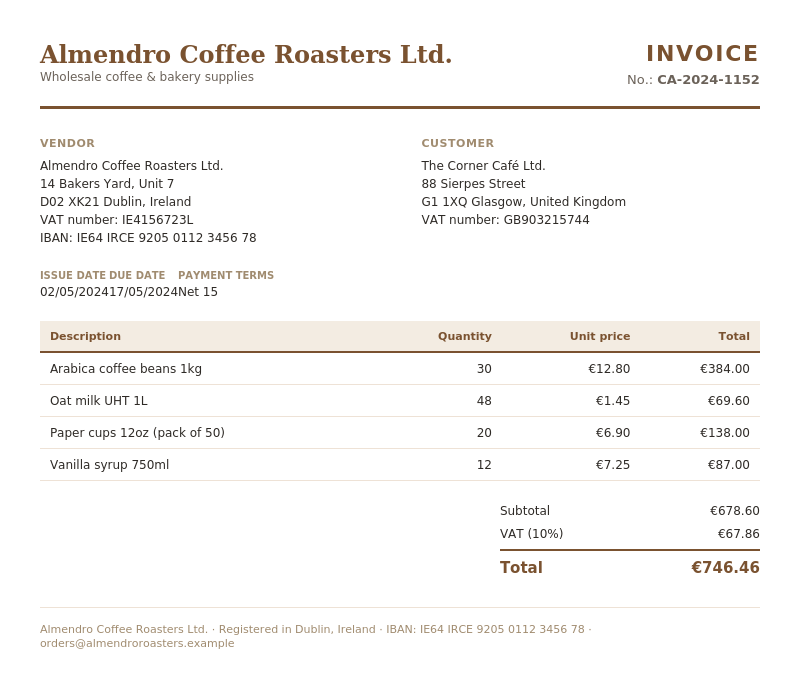
Select a document and press Parse
Want to run it on your own documents?
Ready to dive in? Request a key to get started.Business advantages
- Works out of the box on any invoice layout, with no template training or document setup.
- Returns data in clean JSON, ready to plug into your existing workflow or ERP system.
- Handles the full invoice lifecycle from receipt to approval, not just text extraction.
- Built for both European VAT and US sales tax formats out of the box.
Frequently asked questions
What file formats does the invoice API support?
ByteIt accepts PDF (both native and scanned), JPG, and PNG files. The engine automatically detects whether the file is a native text PDF and applies OCR only when needed, so extraction is as fast and accurate as possible for each input type.
Does the API extract line items from invoices?
Yes. The engine reads line-item tables including description, quantity, unit price, and total price per line. It handles varying column orders, multi-line descriptions, and tables that span multiple pages without requiring a fixed template.
How accurate is the invoice data extraction?
Accuracy depends on the quality of the source document. Clean native PDFs and high-resolution scans typically produce high-confidence results. The output includes structured JSON fields that you can validate and route for exception handling in your own workflow.
Can the API handle low-quality scans or skewed photos of invoices?
Yes. ByteIt's OCR preprocessing handles common image issues including skew, shadows, and moderate resolution loss. For severely degraded documents, the engine still returns the fields it can read with confidence, and you can configure exception routing for the rest.
How do I integrate the invoice API into my existing system?
ByteIt provides a REST API that returns JSON. You can call it directly from your code, or connect it to your ERP, accounting software, or approval workflow using no-code automation tools such as n8n, Zapier, or Make.
Can I process multi-page invoices?
Yes. The engine reads all pages of a multi-page PDF and aggregates fields such as line items, totals, and vendor information across the full document. It does not require one-page-per-document submission.
Does the API extract VAT details for European invoices?
Yes. The engine extracts VAT number, VAT amount, and VAT percentage from invoices that include these fields. It also supports sales tax formats used in the US and other regional tax structures.