
Benefits
Reduce time-to-hire by eliminating manual data entry from CVs into your ATS or HR system
Maintain data consistency across high-volume recruitment pipelines with standardised extraction outputs
Process international candidates without hassle: the engine reads resumes in multiple languages and regional formats
Scale screening operations without adding headcount, from dozens of applications to thousands
How it works
- Step 1
Upload
Send the document to the API as a file or a URL no special formatting required.
- Step 2
The engine reads the document
The engine analyzes the page layout and identifies the content that matters. The engine reads the full textual and spatial content of a resume, identifying and normalising sections such as personal details, work history, education, and skills regardless of layout or language.
- Step 3
Structured JSON is returned
Every extracted element comes back as structured JSON, positioned and typed, ready to feed into downstream systems.
- Step 4
Confidence-based review
Each field carries a confidence score, so low-confidence results can be routed for human review instead of trusted blindly.
Extractable fields
Features
Layout-aware parsing that adapts to free-form, multi-column, and graphically rich resume designs
Extraction of contact details, work experience entries (with dates and employers), education history, and skills
Support for PDF, DOCX, and scanned image uploads, including phone-captured photos of printed CVs
Language detection and content extraction for resumes written in English, French, German, Dutch, Spanish, Italian, and many more
Multi-provider AI architecture (Gemini, OpenAI, Claude) with four configurable parsing levels to balance speed, cost, and accuracy
Use cases
Bulk candidate import into applicant tracking systems
Recruitment agencies and corporate HR teams receive hundreds of CVs per week. ByteIt parses each resume and maps the extracted fields directly into your ATS, populating candidate profiles with contact info, experience summaries, and education records without manual typing.
Skills-gap analysis for workforce planning
Extract every skill mentioned across a pool of internal or external CVs. Aggregate the results to identify strengths and gaps in your talent pipeline, then use the structured data to inform training budgets, recruitment campaigns, or succession planning.
Automated compliance and eligibility screening
Parse work authorisation dates, visa validity periods, and certification expiry dates from CVs automatically. Route candidates whose credentials fall outside required windows to a separate review queue, keeping your hiring process compliant without slowing down.
Multi-language resume normalisation for global hiring
When your organisation recruits across Europe, the Americas, and Asia, resumes arrive in half a dozen languages each with different date and address conventions. ByteIt detects the document language and normalises all extracted fields into a consistent schema, so your recruitment team compares candidates on equal footing.
Data pipeline to downstream HR analytics
Connect the extracted candidate data to your BI or analytics platform using workflow automation tools like n8n, Zapier, or Make. Build dashboards that track sourcing channel performance, time-to-fill by role, or average years of experience per department, all fed by live CV extraction data.
LIVE DEMO
Try it yourself
Upload a sample resume in PDF, DOCX, JPG, or PNG format to see the extracted fields in real time, or load one of our demo files to explore the output.
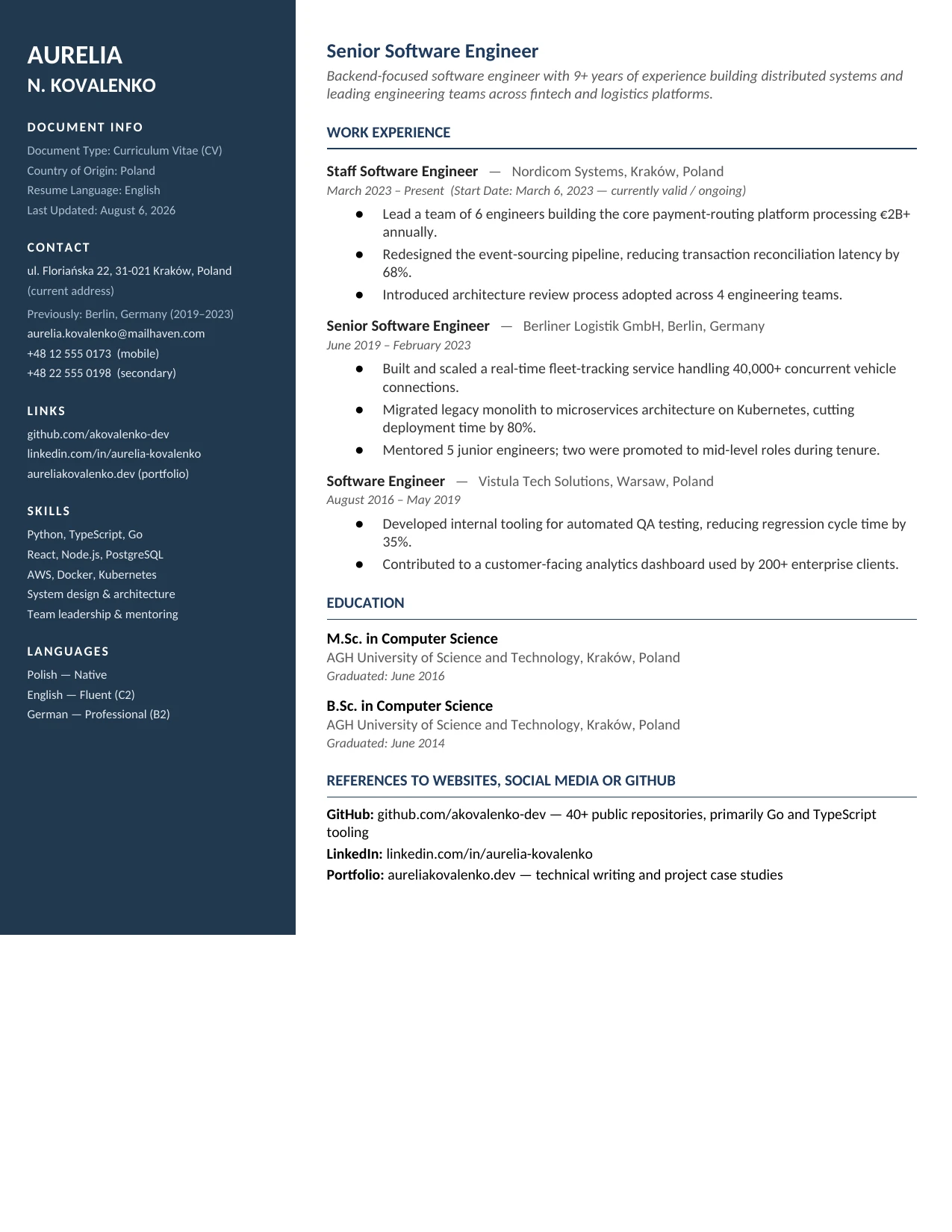
Select a document and press Parse
Want to run it on your own documents?
Ready to dive in? Request a key to get started.Business advantages
- No manual data entry: cut recruitment admin time by a wide margin
- International ready: language detection and multi-region format support
- Flexible deployment: 4 parsing levels let you tune for speed or depth
- Works with any CV layout: free-form, Europass, modern templates, scanned paper
Frequently asked questions
How does ByteIt handle CVs with unusual layouts or infographic-style designs?
The extraction engine uses layout-aware parsing that analyses the spatial arrangement of text blocks, columns, and graphical elements. It does not rely on fixed templates, so infographic CVs, two-column formats, and non-standard section headings are handled without pre-configuration.
What file formats are supported for resume parsing?
ByteIt accepts PDF, DOCX, JPG, and PNG files. Scanned images and phone photos of printed CVs are processed through the same pipeline, making the solution suitable for both digital submissions and paper-to-digital conversion workflows.
Which languages can the engine detect and extract from?
The engine detects the document language and extracts content from resumes written in English, French, German, Dutch, Spanish, Italian, Portuguese, and several other European languages. Language detection is fully automatic and requires no manual selection.
How do I integrate resume extraction into my existing recruitment stack?
ByteIt exposes a REST API that you can call directly from your ATS, HR platform, or backend. For no-code integrations, the output can be routed into downstream systems using workflow automation tools such as n8n, Zapier, or Make.
How is ByteIt's pricing structured for high-volume CV parsing?
ByteIt offers pay-as-you-go and subscription plans with credits per document. For recruitment agencies and enterprise HR teams processing thousands of CVs monthly, volume discounts are available. Visit the ByteIt pricing page for the latest plan details.
Does the parser handle CVs that exceed one page, such as executive profiles?
Yes. The engine processes multi-page documents without truncation. Long-form CVs covering decades of experience, multiple publications, and extensive certification lists are parsed in full, with all sections linked correctly.