Benefits
Eliminate manual reading of lengthy governance documents during due diligence and compliance audits
Centralise governance data from hundreds of entities into a single structured database for portfolio-wide oversight
Reduce turnaround on board-pack preparation by pulling officer lists, meeting rules, and voting requirements in real time
Enable downstream automation by feeding extracted fields into workflow tools such as n8n, Zapier, or Make
How it works
- Step 1
Upload
Send the document to the API as a file or a URL no special formatting required.
- Step 2
The engine reads the document
The engine analyzes the page layout and identifies the content that matters. The extraction engine reads the full text and layout of the bylaw document, identifies standard governance sections and clauses, and maps each to a structured field such as Country of origin, Bylaw language, Entity names and details, Statements of purpose, Categories (Committees, Officers, Meetings, and more), Conflicts of interest, Reference to other legal documents, Applicable law, and Dates and validity.
- Step 3
Structured JSON is returned
Every extracted element comes back as structured JSON, positioned and typed, ready to feed into downstream systems.
- Step 4
Confidence-based review
Each field carries a confidence score, so low-confidence results can be routed for human review instead of trusted blindly.
Extractable fields
Features
Extracts entity names and details, statements of purpose, committee and officer categories, and conflicts of interest
Detects and parses cross-references to other legal documents such as articles of incorporation and shareholder agreements
Handles multi-page bylaws in a single upload, supports PDF, JPG, PNG, TIFF, and DOCX formats
Returns structured output in JSON format, ready for integration with compliance, ERP, or document management systems
Processes scanned images and born-digital documents alike with automatic edge detection and layout analysis
Use cases
Pre-transaction due diligence and M&A review
When evaluating a target company, legal and corporate development teams must review bylaws to understand board composition, voting thresholds, indemnification clauses, and change-of-control provisions. ByteIt's Bylaw OCR extracts these fields from every entity in the deal stack, so reviewers can search, compare, and flag anomalies across dozens of documents instead of reading them cover to cover.
Portfolio governance monitoring for investment firms
Private equity and venture capital firms oversee governance documents across hundreds of portfolio companies. By running each set of bylaws through the extraction API, the central compliance team builds a live database of officer lists, committee structures, meeting frequencies, and conflict-of-interest policies, with alerts when any document is updated.
Board pack and annual meeting preparation
Corporate secretaries assemble board packs that include updated bylaws, officer rosters, and meeting procedures. Automated extraction pulls the current officer names, notice periods, quorum requirements, and voting rules from the latest filing, so the secretary can populate board materials and check compliance with the company's own governance rules in minutes.
Regulatory filing and compliance reporting
Regulated entities such as banks, insurers, and public companies must periodically confirm that their bylaws align with applicable law and regulatory standards. The Bylaw OCR extracts applicable law references, dates and validity periods, and governance categories, enabling automated compliance checks against regulatory templates and reducing the manual effort in each filing cycle.
Integration with workflow automation for downstream systems
Extracted fields can be forwarded to an ERP, contract lifecycle management system, or governance platform via workflow automation tools such as n8n, Zapier, or Make. A law firm, for example, can push extracted officer details directly into its practice management software, or a compliance team can route flagged conflicts-of-interest clauses into a review queue with zero manual data entry.
LIVE DEMO
Try it yourself
Upload a sample bylaw document or use the demo file to see which governance fields ByteIt extracts, works with PDF, JPG, and PNG.
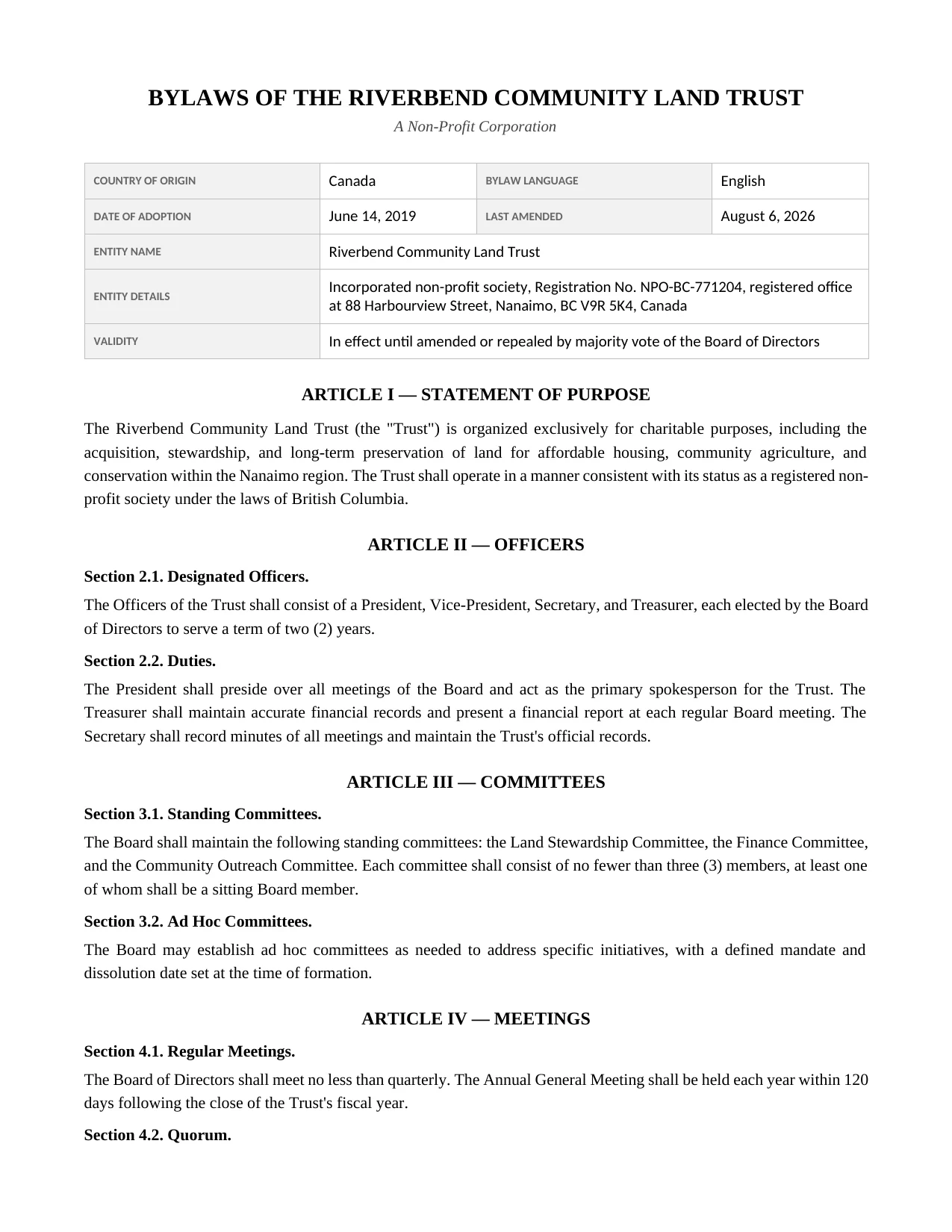
Select a document and press Parse
Want to run it on your own documents?
Ready to dive in? Request a key to get started.Business advantages
- Works with any bylaw format, scanned, digital, single- or multi-page
- No training or setup needed, upload and get structured data back
- Pay-per-page pricing with no monthly minimum commitments
- API-first design integrates into any existing legal tech stack
Frequently asked questions
How is ByteIt's Bylaw OCR priced?
Pricing is usage-based per page or per document, with no monthly minimum or long-term commitment. You can start with free credits to test the API against your own bylaw documents. Volume discounts are available for high-throughput use cases such as portfolio-wide due diligence.
How do I integrate the Bylaw OCR into my existing tools?
ByteIt provides a REST API that can be called from any programming language, as well as an SDK for common languages. You can also connect the API to workflow automation tools like n8n, Zapier, or Make to push extracted fields directly into your CRM, compliance platform, or document management system without writing custom code.
What languages and jurisdictions does the Bylaw OCR support?
The engine is trained on English-language corporate governance documents from US and EU/UK jurisdictions. Language detection is part of the extraction pipeline, so the API identifies and returns the bylaw language as a field. For documents in languages outside these regions, results may vary, contact us to discuss supported language coverage.
What file formats are accepted?
You can upload PDF, JPG, JPEG, PNG, TIFF, and DOCX files. The engine handles both born-digital PDFs and scanned images. Multi-page documents are processed in a single request.
How does the engine handle low-quality scans or faint text?
ByteIt uses adaptive preprocessing that applies deskewing, contrast adjustment, and contrast-limited adaptive histogram equalisation before OCR. For heavily damaged originals, the API still returns the fields it can read with confidence, partial results are rarely empty.
Can it extract fields that are not in the standard list?
Yes. The engine is designed to recognise a broad set of governance clauses and provisions. If you need a field that does not appear in the standard output, the field list can be customised on request. Contact the team with sample documents and your target fields.
Does the API handle multi-page bylaws and tables of contents?
Yes. Bylaws often run 20–50 pages with a table of contents. The engine processes the entire document and preserves the relationship between section headings and their content, so fields such as committee structures and officer categories are parsed in the context of the full document hierarchy.
Related documents
Contracts
Extract parties, contract clauses, signatures, and applicable law from legal contracts using ByteIt's structured data extraction API. Supports PDFs and scanned documents.
Insurance Claims
Extract structured data from insurance claim forms and supporting documents automatically. Claimant details, policy numbers, loss descriptions and more in seconds.
Rental Agreements
Extract tenant details, rent amounts, escalation schedules, and key clauses from residential and commercial rental agreements. AI-powered OCR for any lease format.
Permits
Extract structured data from building permits, environmental permits, and regulatory licences with AI. Capture dates, signees, clauses, risk keywords, and more.