
Benefits
Cut claim processing time by removing manual data entry from paper and image-based submissions
Reduce human error in extracting critical fields like warranty dates, serial numbers, and customer details
Enable faster resolution decisions by making structured claim data available in real time
Scale claims handling without adding headcount, process high volumes during peak periods consistently
How it works
- Step 1
Upload
Send the document to the API as a file or a URL no special formatting required.
- Step 2
The engine reads the document
The engine analyzes the page layout and identifies the content that matters. The engine reads the unstructured text and images inside a warranty claim submission, receipts, invoices, service reports, and claim forms, and identifies warranty-specific fields such as customer details, purchase dates, serial numbers, and resolution requests.
- Step 3
Structured JSON is returned
Every extracted element comes back as structured JSON, positioned and typed, ready to feed into downstream systems.
- Step 4
Confidence-based review
Each field carries a confidence score, so low-confidence results can be routed for human review instead of trusted blindly.
Extractable fields
Features
AI-powered OCR reads printed and handwritten text from scanned receipts, PDF invoices, photos, and digital documents
Pre-configured extraction schema for warranty-specific fields: country of origin, customer names, invoice/receipt numbers, warranty start/end dates, and requested resolution
Supports multi-page documents: extract data from PDFs that combine a receipt, a repair report, and a claim form in one file
Outputs structured JSON, XML, or CSV data ready to forward to claims management or ERP systems
Automatic edge detection and image preprocessing for low-quality scans and phone-camera photos
Use cases
Automated claim triage and routing
When a warranty claim comes in with a photo of a receipt and a written description, extract the purchase date, product identifier, and issue type. Route the claim to the correct team, standard repair, expedited replacement, or out-of-warranty rejection, based on the extracted data, all without a person reading the attachment.
Warranty expiry verification at scale
Process batches of claim attachments against a product database to verify whether each item is still under warranty. Extract warranty start and end dates from the submitted proof-of-purchase, compare them against the product's warranty terms, and flag expired claims automatically.
Integration with claims management and CRM systems
Forward structured claim data, customer name, contact details, invoice number, and requested resolution, directly into your claims management platform or CRM. Use workflow automation tools like n8n, Zapier, or Make to trigger follow-up emails, create support tickets, or update case status without manual data entry.
Legacy document digitalisation for warranty audits
Process a backlog of paper warranty cards, signed service reports, and filed receipts to build a searchable, structured database of past claims. Enable compliance audits, fraud analysis, and trend reporting on repair frequency by product line.
Multi-language claims handling
Receive warranty claims from customers across different regions and extract fields in the claim's original language, including country of origin and warranty claim language fields. Process submissions in English, French, German, Spanish, Italian, and other European languages without changing the extraction pipeline.
LIVE DEMO
Try extracting warranty claim data yourself
Upload a sample warranty claim document in PDF, JPG, or PNG format and see the extracted fields in real time.
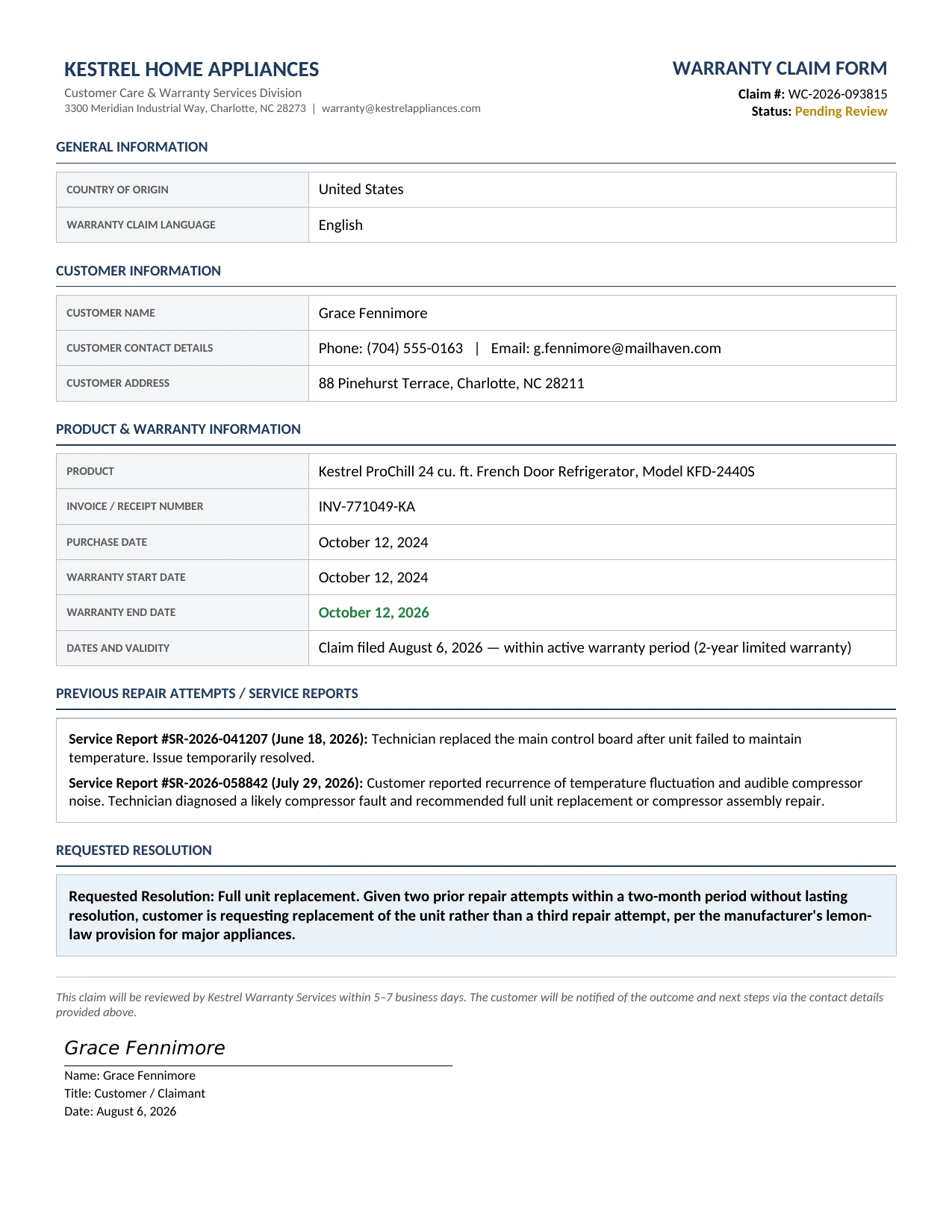
Select a document and press Parse
Want to run it on your own documents?
Ready to automate your claims workflow? Get your API key in Studio.Business advantages
- Process warranty claims up to 70% faster than manual data entry
- Reduce operational costs in customer service and returns departments
- Maintain consistent extraction quality across high-volume claim periods
- Eliminate handwriting interpretation errors from scanned receipts and forms
Frequently asked questions
What file formats does the warranty claims extraction API support?
The API accepts JPG, JPEG, PNG, PDF, DOC, DOCX, XLSX, HEIC, and WEBP. Both single-page and multi-page documents are supported.
Can the engine read handwritten fields on a warranty claim form?
Yes. The AI is trained on printed and handwritten text, including cursive handwriting commonly found on paper claim forms and handwritten repair notes.
How is the data returned after extraction?
Extracted fields are returned as structured JSON, XML, or CSV data, ready to be forwarded to a claims management system, ERP, or custom workflow.
Does it handle low-quality scans or photos of receipts?
Yes. The engine includes automatic edge detection and image preprocessing that improve readability of crumpled receipts, dim photos, and skewed scans before text extraction.
What languages does the warranty claims OCR support?
It extracts fields from documents written in English, French, German, Spanish, Italian, Portuguese, Dutch, and other major European languages.
How do I integrate the extraction into my existing claims system?
Use the REST API or one of the SDKs to send documents and receive structured output. You can also connect the API to your workflow via no-code tools like n8n, Zapier, or Make.
Can it extract data from multi-page PDFs that combine different types of documents?
Yes. The engine processes multi-page files and can extract relevant warranty fields across pages, even when a single PDF contains a receipt, a service report, and a claim form.
Related documents
Contracts
Extract parties, contract clauses, signatures, and applicable law from legal contracts using ByteIt's structured data extraction API. Supports PDFs and scanned documents.
Insurance Claims
Extract structured data from insurance claim forms and supporting documents automatically. Claimant details, policy numbers, loss descriptions and more in seconds.
Proof Of Residence
Extract structured data from proof of residence documents. AI-driven OCR reads utility bills, bank statements, lease agreements and more for KYC compliance.
Property Appraisal Reports
Extract structured data from property appraisal reports, appraised value, comparable sales, property condition, and more. OCR for URAR, 1004, and custom forms.