
Benefits
Eliminate manual rekeying of balance sheet figures for credit analysis, group consolidation, and portfolio monitoring
Receive period-tagged, hierarchical data so subtotals and totals are kept distinct from individual line items
Standardise statements from different accounting frameworks (US GAAP, IFRS) into a single consistent schema
Reduce turnaround time on financial reviews from hours to seconds without sacrificing accuracy
How it works
- Step 1
Upload
Send the document to the API as a file or a URL no special formatting required.
- Step 2
The engine reads the document
The engine analyzes the page layout and identifies the content that matters. The extraction engine reads each balance sheet line by line, identifying the indentation depth, period columns, and section headers to reconstruct the full asset-liability-equity hierarchy with subtotals, totals, and period labels intact.
- Step 3
Structured JSON is returned
Every extracted element comes back as structured JSON, positioned and typed, ready to feed into downstream systems.
- Step 4
Confidence-based review
Each field carries a confidence score, so low-confidence results can be routed for human review instead of trusted blindly.
Extractable fields
Features
Hierarchical extraction that preserves indentation and roll-up structure of assets, liabilities, and equity sections
Multi-period column detection to keep current-period and prior-period amounts separate
Label normalisation across variations such as 'Trade Receivables' vs 'Accounts Receivable' and 'PPE' vs 'Property, Plant and Equipment'
Contra-account handling that correctly treats parenthetical values as negative or deduction entries
Accounting identity verification to flag documents where total assets do not equal total liabilities plus equity
Use cases
Credit and lending analysis
Credit analysts evaluating a commercial loan facility need the latest balance sheet to calculate leverage ratios, working capital, and debt-service coverage. With ByteIt, the statement is extracted and structured within seconds, so the analyst can move straight into ratio analysis rather than retyping figures from a PDF scan or a board-pack printout.
Period-end group consolidation
Accountants rolling up subsidiary statements into a group consolidation receive balance sheets in different formats: QuickBooks exports, audited annual report PDFs, Excel board packs. ByteIt extracts each subsidiary's statement into a standardised schema, making it straightforward to load into consolidation software or a general ledger.
M&A deal screening and due diligence
Private equity associates screen dozens of target companies in the early stages of a deal. Each target provides a balance sheet in a different layout. ByteIt normalises them into a consistent structure, allowing the team to compare current ratios, debt-to-equity, and asset composition across targets without manual reformatting.
Portfolio monitoring and covenant tracking
Lenders and investors track quarterly balance sheet covenants across a portfolio of borrowers. ByteIt extracts each period's statement and flags when a covenant threshold (e.g. minimum current ratio, maximum debt-to-equity) is approaching or breached, using the extracted subtotals directly.
Integration with financial workflow automation
Extracted balance sheet data can be routed into accounting software, ERP systems, or custom dashboards using workflow automation tools such as n8n, Zapier, or Make. Once the data is in JSON format, a downstream process can post journal entries, update a financial model, or trigger an alert when a key metric changes.
LIVE DEMO
Try it yourself
Test balance sheet extraction with a sample document to see the hierarchical result.
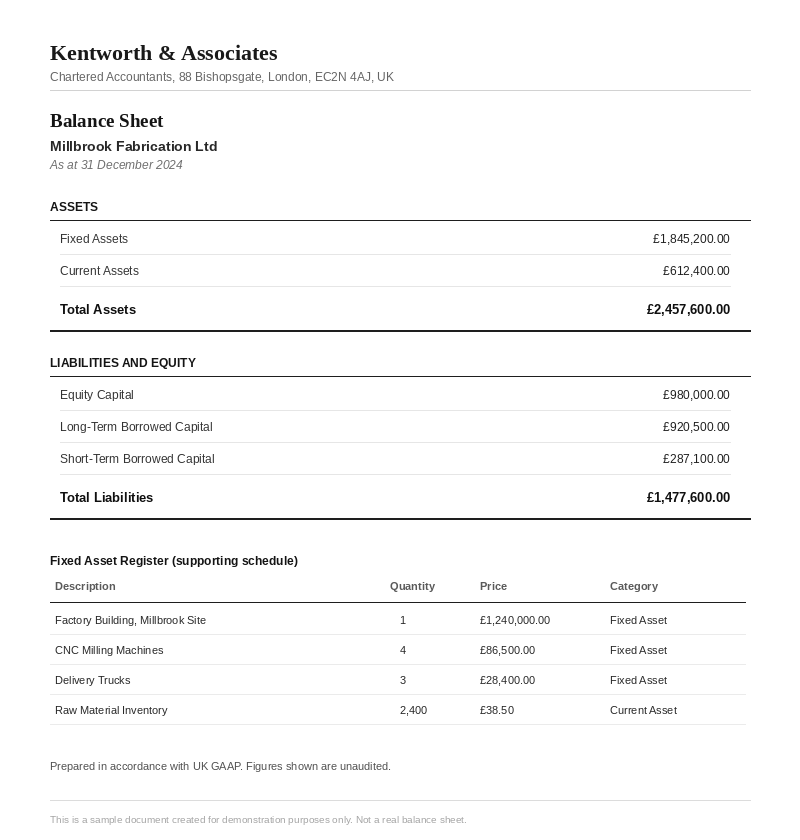
Select a document and press Parse
Want to run it on your own documents?
Ready to dive in? Request a key to get started.Business advantages
- Preserves the full hierarchy of assets, liabilities, and equity including subtotals and totals
- Handles multi-period comparative statements with correct column-to-period mapping
- Works across US GAAP, IFRS, and other accounting framework layouts
- Returns structured JSON ready for downstream financial systems and automation pipelines
Frequently asked questions
How does the API handle the hierarchical structure of a balance sheet?
The engine reads indentation depth and section headings to reconstruct the roll-up hierarchy. Each line item is returned with a reference to its parent subtotal or section, so you know that 'Cash' belongs under 'Current Assets' and 'Current Assets' rolls into 'Total Assets.' Subtotals and totals are preserved as distinct entries rather than being inferred.
Does it support comparative balance sheets with multiple periods?
Yes. When a balance sheet shows two or three periods in adjacent columns, the engine detects the column structure and maps each amount to its correct period (e.g. 31 December 2025 vs 31 December 2024). The output includes a period tag for every extracted value.
What file formats are supported?
ByteIt accepts PDF, Word (DOCX), Excel (XLSX), and common image formats including JPG, JPEG, and PNG. The engine dynamically selects the best extraction route depending on whether the document is a native digital file, a scanned image, or a hybrid.
How is extraction accuracy for low-quality scans or faxed statements?
The engine applies preprocessing steps including deskew, contrast adjustment, and adaptive binarisation before extraction. For scanned or faxed balance sheets where figures may be faint or misaligned, this improves recognition reliability. Accuracy depends on source quality; the output includes a confidence indicator for each extracted field.
Can I connect the extracted data into my accounting or ERP system?
Yes. The API returns structured JSON that can be forwarded to downstream systems via workflow automation tools such as n8n, Zapier, or Make, or fed directly into custom integrations, accounting software, or financial dashboards.
How does pricing work for balance sheet extraction?
ByteIt operates on a credit-based model. The Build plan is free with 1,000 credits per month. The Scale plan is 260 EUR per month for 25,000 credits with parallel processing and team API keys. Enterprise plans have custom pricing with flexible credit limits, zero data retention, and dedicated support.
Does it handle contra accounts and parenthetical values correctly?
Yes. Amounts shown in parentheses (such as accumulated depreciation, treasury stock, or contra-liability entries) are recognised as negative or deduction values and returned as signed numbers rather than being treated as positive entries, preserving the correct arithmetic in the statement.