
Benefits
Eliminate manual data entry: stop typing receipt totals and dates into expense reports – the API extracts them automatically with high accuracy.
Handle any receipt format: trained on receipts from dozens of countries, the engine works with thermal-print receipts, emailed PDFs, mobile photos, and scanned copies.
Capture full line-item detail: extract every item description, quantity, unit price, and product number for granular expense tracking and auditing.
Reduce finance-cycle delays: process receipts in seconds instead of days, accelerating reimbursement cycles and month-end closing.
How it works
- Step 1
Upload
Send the document to the API as a file or a URL no special formatting required.
- Step 2
The engine reads the document
The engine analyzes the page layout and identifies the content that matters. The engine reads printed and handwritten text on receipts, identifying key-value pairs (such as total, date, and merchant name) and table-like line-item blocks, regardless of the receipt's layout, language, or image quality.
- Step 3
Structured JSON is returned
Every extracted element comes back as structured JSON, positioned and typed, ready to feed into downstream systems.
- Step 4
Confidence-based review
Each field carries a confidence score, so low-confidence results can be routed for human review instead of trusted blindly.
Extractable fields
Features
Pre-trained receipt model that recognises merchant name, address, receipt number, total amount, subtotal, VAT percentage, currency, payment method, and more out of the box.
Structured JSON output with all extracted fields, ready to feed into accounting software, expense management tools, or custom workflows.
Line-item extraction returning item descriptions, quantities, unit prices, and product numbers for each individual purchase on the receipt.
VAT and tax detail extraction including VAT percentage, VAT number, and currency – supporting European VAT formats and US sales tax formats.
ByteIt Studio visual interface where you can upload a receipt, define the fields you need, and inspect the extracted output before writing any code.
API-first design with simple REST endpoints and credit-based usage, starting with a free tier of 1,000 credits.
Use cases
Employee expense report automation
Employees photograph receipts after business lunches, taxis, or hotel stays. The API extracts the merchant name, date, total, and VAT. These structured records are then fed into the company's expense management system, cutting reimbursement time from weeks to hours and removing the need for manual data entry.
Accounts payable and purchase reconciliation
Procurement teams match receipts against purchase orders and supplier invoices. ByteIt extracts line-item details from both sides of the transaction, enabling automated three-way matching that flags discrepancies in price, quantity, or VAT before payment is processed.
Personal or corporate tax preparation
During tax season, accountants process hundreds of receipts to calculate deductible expenses. The API extracts VAT amounts, total values, and merchant names, organising everything into a structured dataset that can be exported directly to tax filing platforms or spreadsheets.
Wallet-style receipt digitisation for consumers
Consumer finance apps and digital wallets can use the API to let users snap a photo of any paper receipt. The extracted data is stored in a personal expense ledger, categorised by merchant and spend type, and made searchable – replacing the shoebox full of crumpled paper.
ERP and accounting software integration
Receipt data can be connected into your ERP or accounting software using workflow automation tools like n8n, Zapier, or Make. Once extracted, each receipt becomes a structured record that updates ledgers, generates journal entries, or triggers approval workflows without human intervention.
LIVE DEMO
Try receipt extraction yourself
Test the API with a sample receipt in PDF, JPG, or PNG format to see how ByteIt extracts merchant details, totals, and line items into clean JSON.
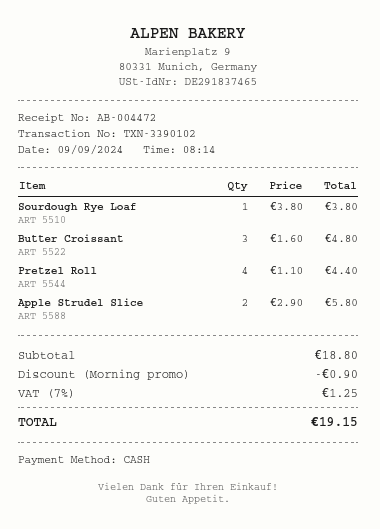
Select a document and press Parse
Want to run it on your own documents?
Ready to dive in? Request a key to get started.Business advantages
- No templates or training required – upload any receipt and get structured data immediately.
- Free tier includes 1,000 credits so you can test with real documents before committing.
- Pay only for what you use with transparent, credit-based pricing starting at €0.015 per extra credit.
- Works with poor-quality inputs – faded thermal paper, low-light photos, and handwritten receipts are all handled by the engine.
Frequently asked questions
What does the receipt data extraction API cost?
ByteIt offers a free tier with 1,000 credits (€0/month) to try the receipt parser with your own documents. The paid plan is €260/month for 25,000 credits, with additional credits at €0.011 each. Yearly billing saves 20%. Each API call consumes a number of credits based on the document complexity.
How do I integrate the receipt API into my application?
ByteIt provides a standard REST API. You send the receipt image or PDF to the endpoint and receive structured JSON back. The ByteIt Studio also lets you test extraction visually before writing any code. You can connect the output to downstream systems using workflow automation tools.
What receipt formats and languages are supported?
The engine accepts PDF, JPG, and PNG files. It is trained on receipts from dozens of countries and handles multiple languages, including European languages commonly found on receipts. It works with thermal-print receipts, scanned copies, mobile photos, and digital PDF receipts.
Can it extract line items from complex receipts?
Yes. The engine detects table-like structures within receipts and extracts each line item individually, including the description, quantity, unit price, and product number where present. This is useful for expense categorisation, procurement matching, and audit trails.
How does it handle poor-quality or damaged receipts?
The engine is designed to work with real-world receipt conditions: faded thermal paper, crumpled scans, low-light mobile photos, and handwritten amounts. Pre-processing steps handle image deskewing and contrast adjustment before extraction.
Can it extract VAT and tax information?
Yes. The receipt parser extracts VAT percentage, VAT amount, and the merchant's VAT number where present. It handles both European VAT formats and US sales tax formats, making it suitable for cross-border expense management.