
Benefits
Reduce manual data entry for death certificate processing, cutting hours of clerical work per record
Accelerate estate settlement and life insurance claim handling by delivering extracted data in seconds
Improve accuracy of vital records digitisation, reducing errors from hand-transcription of complex medical and legal fields
Enable bulk processing of historical death certificates for genealogical and epidemiological research
How it works
- Step 1
Upload
Send the document to the API as a file or a URL no special formatting required.
- Step 2
The engine reads the document
The engine analyzes the page layout and identifies the content that matters. ByteIt's engine reads the layout of US Standard Certificates of Death, extracting typed or handwritten information from each labelled field block, including decedent demographics, cause-of-death details, and certifying physician credentials.
- Step 3
Structured JSON is returned
Every extracted element comes back as structured JSON, positioned and typed, ready to feed into downstream systems.
- Step 4
Confidence-based review
Each field carries a confidence score, so low-confidence results can be routed for human review instead of trusted blindly.
Extractable fields
Features
Extracts all key fields from US Standard Certificate of Death forms, including decedent name, SSN, date of birth, date of death, and place of death
Captures cause of death information and certifying physician details (name, signature, licence number)
Parses residence address components: street, city, state, county, ZIP code, and inside-city-limits indicator
Handles scanned certificates, photographs, and digital PDFs across varying image quality
Outputs structured JSON that can be integrated into vital records systems, FHIR-based workflows, and case management platforms
Use cases
Life Insurance Claims Processing
Insurance providers receive death certificates as part of claim packages. By extracting decedent name, date of death, cause of death, and certifying physician details automatically, claims adjusters can validate policy information, update case status, and initiate payout workflows without manual data rekeying. Extracted data can be routed to claims management systems through workflow automation tools like n8n or Zapier.
Estate Administration and Probate
Law firms and estate executors process death certificates to open probate, notify beneficiaries, and settle debts. Automated extraction of the decedent's name, SSN, date of death, and marital status populates court filing templates and estate accounting software, reducing turnaround time from weeks to days.
Vital Records Digitisation for Public Health Agencies
State and county vital records offices handle thousands of death certificates annually. ByteIt enables bulk ingestion of scanned certificates, extracting structured demographic and medical data for electronic registries, public health reporting (e.g. NCHS submissions), and mortality statistics without manual keying.
Genealogical and Academic Research
Researchers digitising historical death certificate collections can use ByteIt to extract names, dates, places of birth and death, and cause-of-death fields at scale. The structured output feeds family history databases, epidemiological studies, and demographic analysis without the cost of manual transcription.
Integration with FHIR-Based Health Information Systems
Healthcare organisations that exchange death records using the HL7 VRDR FHIR Implementation Guide can feed ByteIt's extracted fields into FHIR-compliant resources such as Decedent, DecedentAge, and DeathCertificate profiles. This enables automated record submission from EHR systems to jurisdictional vital records offices.
LIVE DEMO
Try death certificate extraction yourself
Upload a sample death certificate (PDF, JPG, or PNG) below to see how ByteIt extracts the decedent's name, dates, cause of death, and physician details in real time.
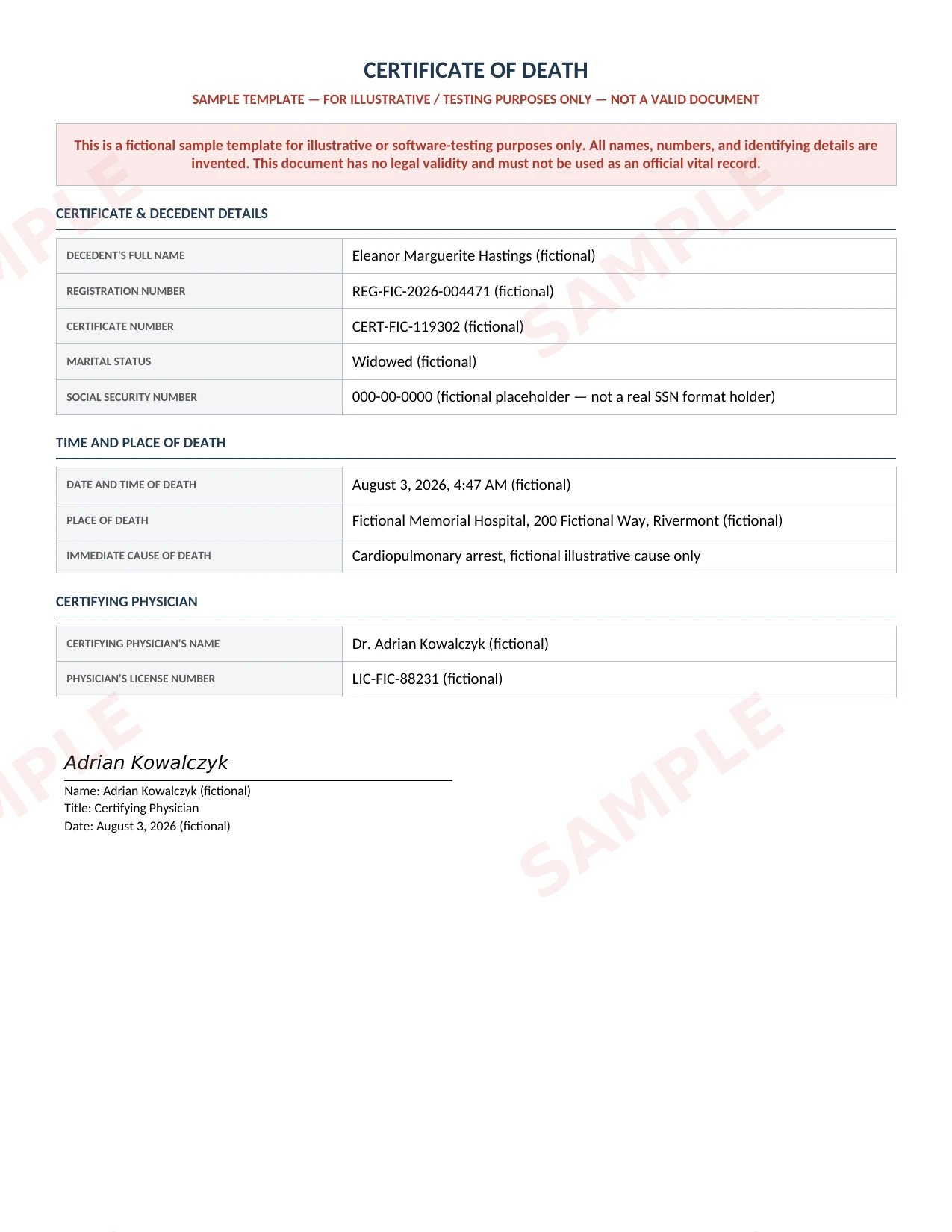
Select a document and press Parse
Want to run it on your own documents?
Ready to dive in? Request a key to get started.Business advantages
- Works with scanned and photographed certificates, no template setup required
- Outputs structured JSON ready for integration into vital records and claims systems
- Processes individual documents or batch uploads for high-volume workflows
- Available via REST API with clear documentation and quick onboarding
Frequently asked questions
What information can be extracted from a death certificate?
ByteIt extracts decedent legal name, sex, Social Security Number, date of birth, date and time of death, place of death, age at death, birthplace, residence address, marital status, military service indicator, cause of death, and certifying physician name, signature, and licence number, among other fields.
Which death certificate formats are supported?
ByteIt handles digital PDFs, scanned images, and photographs of death certificates. The engine is trained on US Standard Certificate of Death layouts but can adapt to slight format variations across states.
How do I integrate the death certificate extraction API?
ByteIt provides a REST API with endpoints for document submission and retrieval of extracted JSON. Integration can be done directly via HTTP requests, or through workflow automation platforms such as n8n, Zapier, or Make for no-code setups.
Can it handle poor-quality scans or handwritten entries?
Yes, the engine is designed to work with varied image quality, including low-resolution scans and photographs. Handwritten fields are processed using OCR and machine learning, though accuracy may vary depending on legibility.
How is the extracted data priced?
ByteIt uses a credit-based pricing model. Each document processed consumes a number of credits depending on complexity. For current pricing and plan details, visit the ByteIt pricing page.
Can death certificate data be submitted to vital records systems?
Yes. The structured JSON output can be mapped to FHIR VRDR profiles or custom electronic death registration system formats, enabling automated submission to jurisdictional vital records offices and NCHS.
Related documents
Contracts
Extract parties, contract clauses, signatures, and applicable law from legal contracts using ByteIt's structured data extraction API. Supports PDFs and scanned documents.
Insurance Claims
Extract structured data from insurance claim forms and supporting documents automatically. Claimant details, policy numbers, loss descriptions and more in seconds.
Warranty Claims
Extract structured data from warranty claims automatically. Capture customer details, dates, and claim resolution using AI-powered OCR.
Proof Of Residence
Extract structured data from proof of residence documents. AI-driven OCR reads utility bills, bank statements, lease agreements and more for KYC compliance.
Property Appraisal Reports
Extract structured data from property appraisal reports, appraised value, comparable sales, property condition, and more. OCR for URAR, 1004, and custom forms.