
Benefits
Cut manual data entry: eliminate the need for staff to read and retype meter readings from photos or scanned cards, reducing transcription errors near zero.
Speed up billing and reconciliation: get structured consumption data in seconds, not days, close month-end and tenant billing cycles faster.
Scale across sites and providers: handle any meter type and any provider's meter card format without training per template.
Audit-ready data trail: every extraction preserves the original document reference, making it easy to trace a reading back to its source for compliance or dispute resolution.
How it works
- Step 1
Upload
Send the document to the API as a file or a URL no special formatting required.
- Step 2
The engine reads the document
The engine analyzes the page layout and identifies the content that matters. The extraction engine reads the document image or PDF, identifies regions containing the meter reading, serial number, and supporting context (provider name, account number, address), and returns those values as structured fields in a consistent JSON schema.
- Step 3
Structured JSON is returned
Every extracted element comes back as structured JSON, positioned and typed, ready to feed into downstream systems.
- Step 4
Confidence-based review
Each field carries a confidence score, so low-confidence results can be routed for human review instead of trusted blindly.
Extractable fields
Features
Extracts key meter fields including meter reading, meter serial number, meter type (electric, gas, water, heat), utility type, unit of measurement, timestamp, and address details.
Accepts images (JPG, PNG) and PDFs, works with photos taken on-site by field technicians as well as scanned meter cards and digital PDFs.
Supports GPS coordinates and optional photo capture to geo-locate every reading for site-level tracking.
Returns structured JSON that can be routed directly into ERP systems, energy dashboards, or tenant billing software.
Use cases
Tenant utility billing and sub-metering
Property managers and multi-site operators collect meter readings across dozens or hundreds of units each month. ByteIt extracts the consumption value and unit from each meter card or photo, then the structured data can be pushed into tenant billing software via workflow automation tools like n8n, Zapier, or Make, eliminating manual spreadsheet entry and speeding up invoice generation.
Energy monitoring and sustainability reporting
Organisations tracking energy usage across facilities need consistent monthly consumption data. Field technicians photograph gas, electricity, and water meters during rounds. ByteIt extracts the reading, timestamp, and meter serial number from each photo and feeds the structured data into an energy dashboard or sustainability platform for interval comparison and carbon reporting.
Meter reading validation and exception handling
When a reading falls outside expected consumption patterns, it needs to be flagged before it hits the billing system. ByteIt's structured output includes the raw reading and unit, which can be compared against historical averages in downstream logic. Discrepancies trigger an exception workflow, prompting a re-read or a site visit, while normal readings flow straight through to the billing engine.
Reconciliation of third-party meter reading services
Companies that outsource meter reading to third-party vendors receive reading reports in varied formats. ByteIt extracts the reading, meter ID, and date from each vendor's document, normalising them into a single schema. The data can then be reconciled against expected reads and used to verify vendor invoices for reading services.
LIVE DEMO
Try it yourself
Upload a sample meter document, PDF, JPG, or PNG, and see the extracted fields in real time.
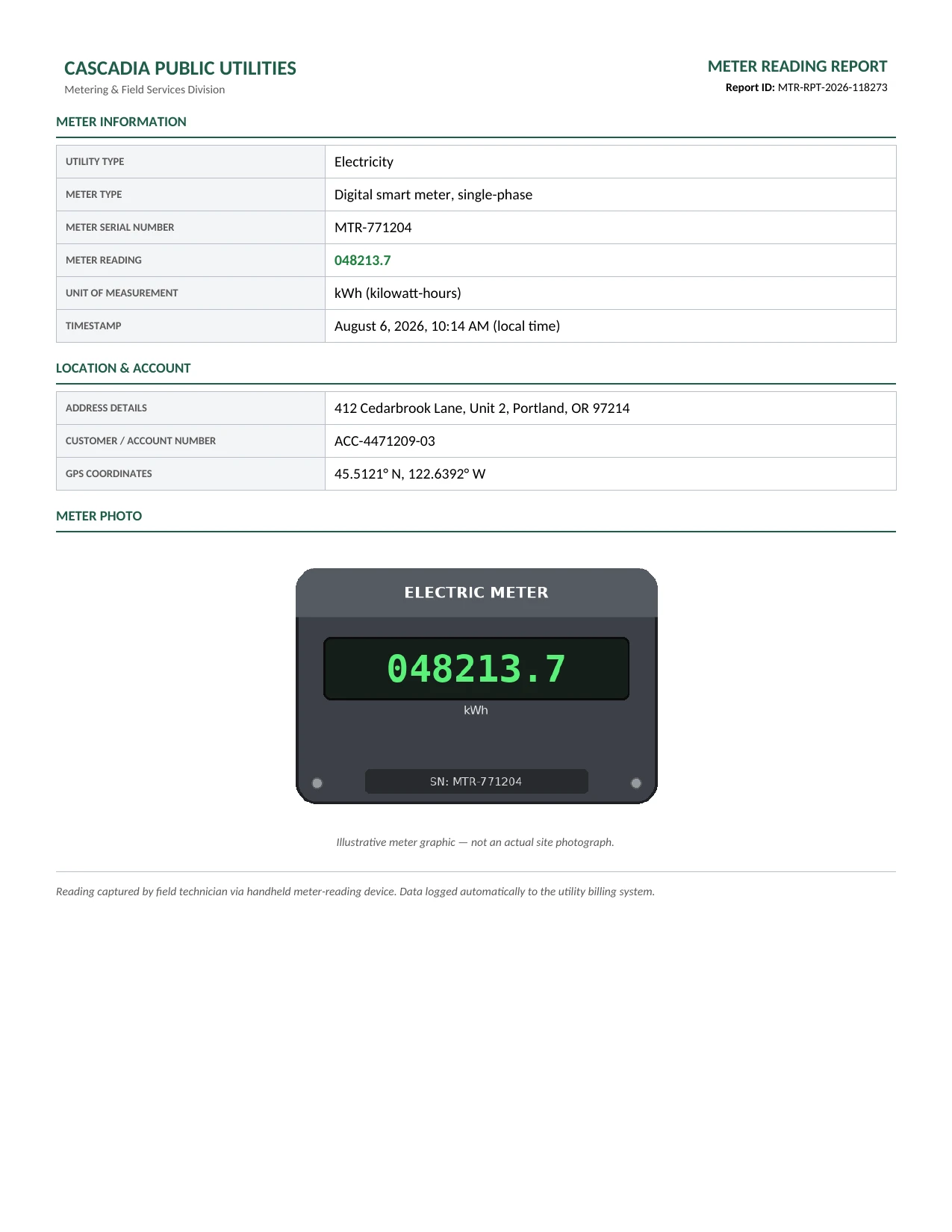
Select a document and press Parse
Want to run it on your own documents?
Ready to dive in? Request a key to get started.Business advantages
- No template training needed, works out of the box on any meter card or photo format.
- Single API for all meter types, electricity, gas, water, and heat from one integration.
- GPS and photo capture support for field verification and asset tracking.
- Structured JSON output ready to feed into billing, ERP, or analytics systems.
Frequently asked questions
What file formats does the utility meter extraction API support?
The API accepts PDFs (both digital and scanned), JPG, and PNG files. This covers photos taken on-site by technicians, scanned meter cards, and PDF reports from third-party reading services.
Can it extract readings from photos taken in poor lighting or at awkward angles?
Yes. The engine includes preprocessing steps that handle low-light images, skewed angles, and partially obscured displays. It is designed to work with real-world field conditions rather than assuming perfectly framed, studio-quality photos.
What meter types are supported?
Electricity, gas, water, and heat (district heating) meters are all supported. The API returns the meter type and utility type as separate fields so downstream logic can distinguish between a kWh reading on an electric meter and a cubic metre reading on a water meter, for example.
What is the pricing model for the API?
ByteIt offers a usage-based pricing model with a free tier for initial testing. You can find current pricing, credit limits, and plan details on the ByteIt pricing page. There are no long-term commitments and no setup fees.
How do I integrate utility meter extraction into my existing workflow?
ByteIt provides a REST API with SDKs for Python, Node.js, and other common languages. You can also connect the API to no-code workflow tools like n8n, Zapier, or Make for trigger-based automation, for example, automatically processing meter photos as soon as they are uploaded to a shared folder.
How accurate is the reading extraction for utility meters?
Accuracy depends on document quality and layout complexity. For clear digital PDFs or well-lit photos of digital displays, accuracy is very high. For handwritten analogue meter readings or heavily damaged documents, accuracy may be lower. The engine returns confidence metadata that lets you flag borderline extractions for manual review.
Does it handle multi-page meter documents?
Yes. If a meter card or reading report spans multiple pages, the engine processes all pages and consolidates the extracted data. Each reading is associated with its page context so you can trace back to the source.
Related documents
Price Tags
Extract product name, brand, price, barcode, SKU and more from price tags with ByteIt's AI-powered OCR API. Automate retail data collection and market research.
Menu Cards
Extract structured data from restaurant menu cards with AI-powered OCR. Capture item names, prices, ingredients, allergens, and more from PDFs and images.