
Benefits
Removes manual rekeying of borrower data, cutting processing time per application from minutes to seconds.
Reduces data entry errors that can delay underwriting or trigger compliance re-reviews.
Enables straight-through processing for mortgage applications by feeding verified data directly into LOS platforms.
Scales across high-volume lending operations without adding headcount during peak refinance seasons.
How it works
- Step 1
Upload
Send the document to the API as a file or a URL no special formatting required.
- Step 2
The engine reads the document
The engine analyzes the page layout and identifies the content that matters. The extraction engine reads the layout of the Form 1003, including its multi-section structure of borrower details, employment history, assets and liabilities, and loan terms, returning each field as structured data.
- Step 3
Structured JSON is returned
Every extracted element comes back as structured JSON, positioned and typed, ready to feed into downstream systems.
- Step 4
Confidence-based review
Each field carries a confidence score, so low-confidence results can be routed for human review instead of trusted blindly.
Extractable fields
Features
Extracts borrower and co-borrower details including full name, SSN/TIN, date of birth, marital status, and number of dependents.
Reads current employment information such as employer name, job title, length of employment, and monthly income.
Captures loan-specific fields including loan purpose (purchase or refinance), mortgage type (fixed or adjustable), loan amount requested, and property value.
Identifies asset and liability entries from the borrower's financial summary sections.
Returns all extracted data in JSON format compatible with downstream workflow automation tools like n8n, Zapier, or Make.
Use cases
Mortgage Loan Origination Automation
Capture borrower information from scanned or uploaded Form 1003 documents and push structured data into a loan origination system (LOS). Lenders can pre-populate application records, flag missing fields, and move applications to underwriting without manual data entry.
Refinance Pipeline Acceleration
During refinance waves, process hundreds of Form 1003 applications per day by extracting borrower income, employment length, and existing loan details automatically. Loan officers can focus on rate and term decisions rather than rekeying paper forms.
Underwriting Data Quality Checks
Extract all financial fields from Form 1003 and validate consistency against supporting documents (bank statements, payslips, tax forms) using automated rules. Flag mismatches in declared income, asset values, or employment dates before human review.
LOS and Workflow Integration
Connect extracted Form 1003 data to downstream systems through workflow automation tools like n8n, Zapier, or Make, feeding structured records into loan origination software, compliance databases, and borrower communication platforms without custom middleware.
Digital Mortgage Application Portals
Enable borrowers to upload a completed Form 1003 directly through a lender's portal. ByteIt extracts the fields in real time, allowing the borrower to review prefilled data and correct any mistakes before submission, reducing application errors at the source.
LIVE DEMO
Try Form 1003 extraction yourself
Upload a sample Uniform Residential Loan Application (PDF, JPG, or PNG) and see the extracted borrower and loan fields returned as structured JSON in seconds.
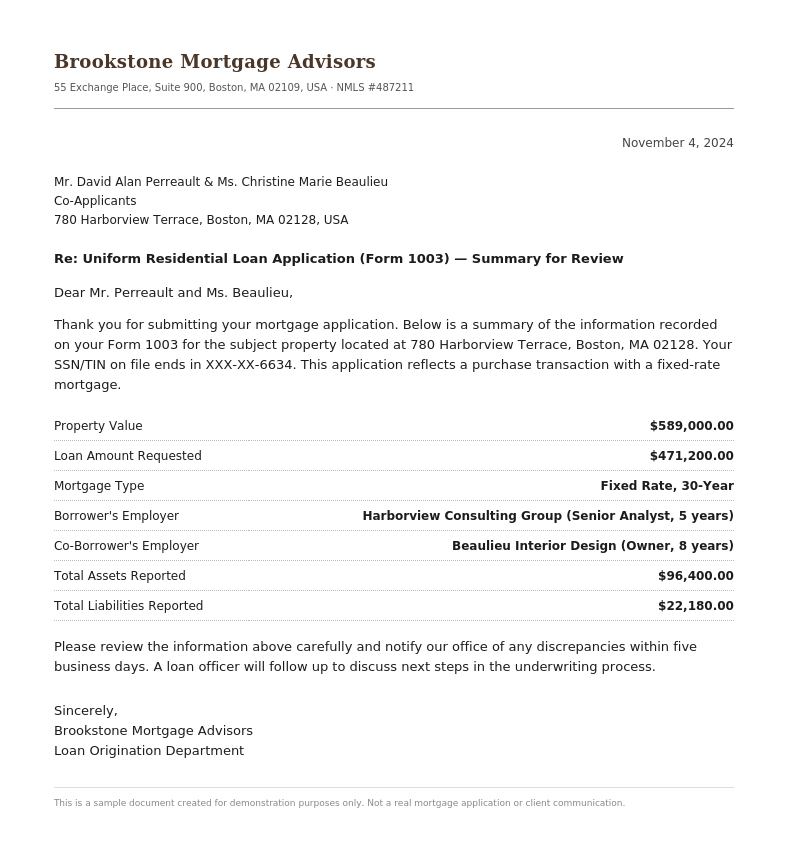
Select a document and press Parse
Want to run it on your own documents?
Ready to dive in? Request a key to get started.Business advantages
- Pre-built for US residential mortgage workflows out of the box.
- No template training needed: the engine handles the standard Form 1003 layout as shipped.
- Returns data in developer-friendly JSON for any downstream LOS or automation tool.
- Credit-based pricing means you only pay for what you process, starting at 0€.
Frequently asked questions
What is Form 1003 used for?
Form 1003 is the Uniform Residential Loan Application used by nearly all mortgage lenders in the United States. Borrowers complete it to provide their financial information, employment history, assets, and the loan terms they are applying for. It is the standard data source for underwriting a residential mortgage.
What file formats does the extraction API support?
ByteIt accepts PDF, Word (.docx), PowerPoint (.pptx), HTML, Markdown, plain text, and common image formats including PNG, JPEG, TIFF, and BMP. Scanned or photographed copies of Form 1003 work as long as the text is legible.
Can it handle multi-page Form 1003 documents?
Yes. The engine processes multi-page documents and extracts fields across all pages. You can also specify a page range using the API's page_range parameter if you only need a subset of the document.
How do I integrate the extracted data into my loan origination system?
ByteIt returns data as structured JSON. You can connect the API to your LOS using workflow automation tools such as n8n, Zapier, or Make, or write a direct integration using ByteIt's REST API and Python SDK.
How accurate is the extraction for Form 1003?
ByteIt combines Vision-Language Models with specialised extraction layers to handle both typed and handwritten fields on Form 1003. Accuracy depends on scan quality and handwriting legibility. You can review confidence indicators in the API response to flag uncertain values for manual verification.
What is the pricing for extracting Form 1003 data?
ByteIt uses a credit-based pricing model. The Build plan is free with 1,000 credits per month, and the Scale plan is 260€ per month for 25,000 credits. A standard digital PDF uses 1 credit, while complex or handwritten scans use 2 credits. See the pricing page for details.
Related documents
Loan Application
Extract borrower data from Uniform Residential Loan Application (Form 1003/URLA) documents. Automate mortgage origination with AI-powered data extraction.
Bank Statement
Extract account holder, IBAN, transaction dates, debit/credit amounts, and balances from PDF and scanned bank statements with ByteIT's OCR API.
Irs Tax Form
Extract structured data from IRS Form 1040 tax returns using AI. Capture taxpayer info, income, deductions, filing status, and refund amounts from PDFs and scans.