
Benefits
Eliminates manual data entry from loan applications, cutting processing time per file from minutes to under a second
Reduces keystroke errors in borrower Personally Identifiable Information (PII) and financial figures that can delay underwriting or trigger compliance flags
Enables straight-through processing of clean applications by feeding extracted fields directly into your LOS or decisioning platform
Scales cost-effectively during volume peaks, no need to hire temporary back-office staff when application volumes surge
How it works
- Step 1
Upload
Send the document to the API as a file or a URL no special formatting required.
- Step 2
The engine reads the document
The engine analyzes the page layout and identifies the content that matters. ByteIt's extraction engine reads filled Uniform Residential Loan Application forms (Fannie Mae 1003 / Freddie Mac 65), interpreting checkbox selections, handwritten entries, typed text, and table layouts across all sections, borrower information, employment, assets, liabilities, loan details, and signatures.
- Step 3
Structured JSON is returned
Every extracted element comes back as structured JSON, positioned and typed, ready to feed into downstream systems.
- Step 4
Confidence-based review
Each field carries a confidence score, so low-confidence results can be routed for human review instead of trusted blindly.
Extractable fields
Features
Extracts borrower personal details, including full name, Social Security Number (SSN), date of birth, citizenship type, marital status, and number of dependents
Captures current, additional, and previous employment information, employer name, address, position, start/end dates, and gross monthly income
Reads asset account details across checking, savings, retirement, and investment accounts, including financial institution name, account number, and cash or market value
Parses loan-specific fields: requested loan amount, loan purpose, property address, intended occupancy type, and collateral description
Handles multi-page URLA forms in a single API call, including all sections from borrower information through declarations and signatures
Delivers results in structured JSON, Markdown, or table formats for direct integration into downstream systems
Use cases
Automated mortgage origination intake
When a borrower submits a completed URLA through a digital portal or in-branch, ByteIt extracts all fields and pushes structured data directly into your LOS. Loan officers receive a pre-populated application review screen instead of a PDF to retype, cutting intake time from 20 minutes to near-zero.
Pre-underwriting validation and flagging
Extracted data can be checked against loan program rules before formal underwriting begins. For example, the engine captures self-employment flags and income figures, which can trigger automated requests for additional documentation (tax returns, P&L statements) without a human touching the file.
Audit-ready compliance archiving
Every extraction produces a timestamped, structured record of every field from the loan application. This creates a verifiable audit trail for HMDA reporting, fair lending reviews, and investor quality-control audits without requiring back-office staff to re-verify application data against scanned PDFs.
Connected workflow automation
Route extracted loan application data to your CRM, LOS, or document management platform using workflow automation tools such as n8n, Zapier, or Make. Trigger automated notifications, pre-fill downstream forms, or sync borrower data across systems without manual intervention.
Bulk portfolio review and refinancing campaigns
For lenders reviewing existing portfolios for refinancing opportunities, ByteIt can batch-process hundreds of archived loan applications, extracting borrower and property data at scale. This enables data-driven outreach campaigns without manual file review.
LIVE DEMO
Try it yourself
Upload a sample Uniform Residential Loan Application in PDF, JPG, or PNG format and see the extracted borrower, employment, asset, and loan fields returned as structured JSON in seconds.
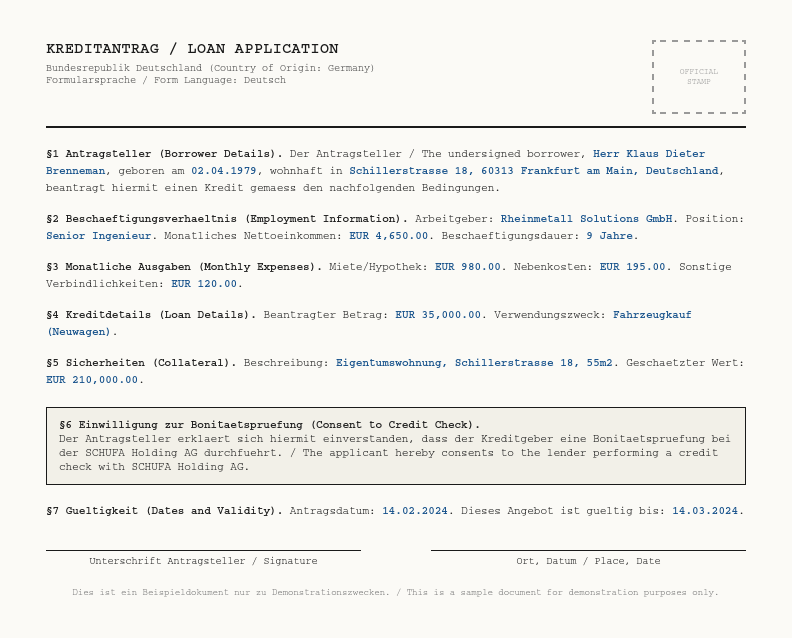
Select a document and press Parse
Want to run it on your own documents?
Ready to dive in? Request a key to get started.Business advantages
- Works with any URLA layout, digital, scanned, handwritten, or printed, without templates or training
- GDPR-compliant and ISO/IEC 27001 certified with EU hosting
- Sub-second latency per page, built for real-time origination workflows
- Simple REST API with Python SDK, or connect via n8n, Zapier, and Make
Frequently asked questions
Which loan application forms does ByteIt support?
ByteIt's engine is built for the US Uniform Residential Loan Application (Fannie Mae Form 1003 / Freddie Mac Form 65), including both the original and the redesigned 2021 URLA format. The model reads all sections of the form from borrower information through declarations and signatures.
Can it read handwriting on a paper 1003 form?
Yes. ByteIt handles scanned paper applications with handwritten entries, including checkbox selections, written-in figures, and signatures. The engine uses vision-language models that understand document layouts holistically, not just typed text.
What file formats are supported?
You can upload PDF (including multi-page), Word documents, Excel files, and image formats such as JPG and PNG. The API processes each file and returns structured data regardless of the input format.
How do I integrate the extraction into my loan origination system?
ByteIt provides a straightforward REST API with a Python SDK. You can call the API directly from your LOS backend or use workflow automation tools like n8n, Zapier, or Make to connect ByteIt with your existing systems without custom development.
Is the extracted data secure enough for borrower PII?
Yes. ByteIt is GDPR-compliant and ISO/IEC 27001 certified. All data is encrypted end-to-end, and you can opt for zero-retention or EU-hosted VPC deployment for Enterprise plans. The platform is designed for the strict data privacy requirements of mortgage lending.
What is the pricing model?
ByteIt offers a free Build plan with 1,000 pages per month, a Scale plan at 260 EUR per month for 25,000 pages with parallel processing and team API keys, and an Enterprise plan with custom pricing for flexible volume, zero data retention, VPC or on-premise deployment, and dedicated support.
Does it handle multi-page URLA documents?
Yes. The full 1003 form spans several pages including borrower information, employment, assets, liabilities, and declarations. ByteIt processes the entire document in a single API call and returns all extracted fields together in one structured response.
Related documents
Bank Statement
Extract account holder, IBAN, transaction dates, debit/credit amounts, and balances from PDF and scanned bank statements with ByteIT's OCR API.
Invoice
Extract invoice number, vendor data, line items, VAT, and totals from PDF invoices, scanned invoices, and receipt images with ByteIt's invoice data extraction API.
Credit Card Statement
Extract transactions, balances, and payment details from any credit card statement with AI. Parse Visa, MasterCard, Amex and more into structured JSON.
Debit Credit Card
Extract card number, cardholder name, expiration date, CVC and issuer from debit and credit cards with ByteIt's AI-powered API. Supports photos, scans and PDFs.