
Benefits
Eliminates manual rekeying of AWB numbers, shipper details, and charge codes across multiple systems, cutting data entry time from minutes to seconds per document.
Reduces customs clearance delays caused by transcription errors in shipper/consignee addresses, commodity descriptions, or declared value fields.
Enables same-day billing by pushing extracted charge data straight into invoicing and reconciliation workflows without waiting for manual review.
Supports high-volume cargo operations by processing batches of AWBs in parallel, with no template setup required for different carrier formats.
How it works
- Step 1
Upload
Send the document to the API as a file or a URL no special formatting required.
- Step 2
The engine reads the document
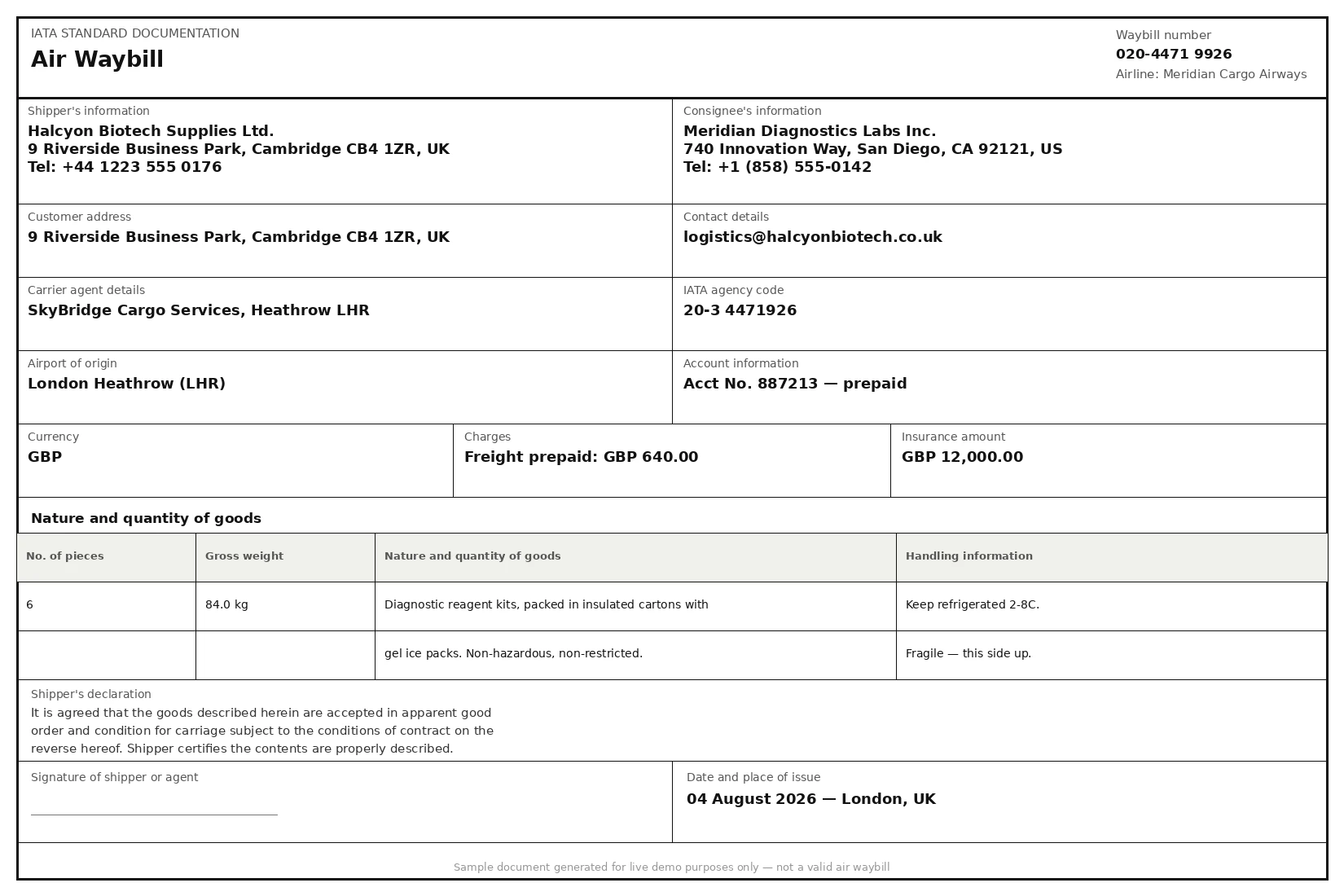
The engine analyzes the page layout and identifies the content that matters. The extraction engine reads air waybills of any airline or forwarder layout, identifying shipper and consignee party data, carrier agent codes, airport routing, cargo line items (pieces, weight, commodity description), and the full charge breakdown from both standard IATA and carrier-specific AWB formats.
- Step 3
Structured JSON is returned
Every extracted element comes back as structured JSON, positioned and typed, ready to feed into downstream systems.
- Step 4
Confidence-based review
Each field carries a confidence score, so low-confidence results can be routed for human review instead of trusted blindly.
Extractable fields
Features
Layout-agnostic AI that reads air waybills from any airline or freight forwarder without pre-configured templates or training on carrier-specific formats.
Extracts granular shipper and consignee data including name, full address, account numbers, and tax ID fields separately for each party.
Captures carrier agent details, IATA agency codes, airport origin/destination codes, flight routing, and waybill numbers in structured format.
Recognises package count, nature and quantity of goods, gross weight, chargeable weight, dimensions, handling instructions, and special codes (e.g. perishable, dangerous goods).
Outputs charges, currency, insurance amount, account information, and carrier declaration fields as structured data for downstream billing and audit systems.
REST API with Python SDK, returning clean JSON ready for integration into TMS, ERP, or customs filing platforms.
Use cases
Air Freight Billing Automation
Extract all chargeable fields from incoming AWBs -- freight charges, valuation charges, taxes, and total amounts -- and feed them into your billing or ERP system. This eliminates manual invoice matching, reduces disputes with carriers, and cuts the billing cycle from days to hours.
Customs Clearance Data Preparation
Use extracted AWB data (shipper, consignee, commodity description, weight, declared value) to pre-populate customs declaration forms and ensure shipment details match supporting documents like commercial invoices and packing lists. Faster, more accurate data at the point of entry reduces the risk of customs holds.
Freight Forwarder Operational Dashboard
Aggregate AWB data from multiple carriers and forwarders into a single operational view. Track incoming shipments by origin, destination, total weight, and handling status in real time, giving logistics coordinators visibility without manual spreadsheet consolidation.
Cargo Handling and Warehouse Intake
When AWBs arrive ahead of or alongside physical cargo, extract the piece count, weight, and special handling instructions to pre-assign warehouse resources, plan unloading priorities, and flag dangerous goods or temperature-sensitive shipments before they reach the facility.
ERP and TMS Integration via Workflow Automation
Connect extracted AWB data to your transport management system, ERP, or accounting software using workflow automation tools like n8n, Zapier, or Make. Route structured shipment records into existing purchase order and inventory workflows with no custom middleware.
LIVE DEMO
Try it yourself
Upload a sample air waybill (PDF, JPG, or PNG) below and see the extracted fields returned as structured JSON in seconds.
Select a document and press Parse
Want to run it on your own documents?
Ready to dive in? Request a key to get started.Business advantages
- Sub-second processing per page with no template setup.
- Pay-as-you-go pricing from €0 to start, with 1,000 free extractions per month.
- GDPR-compliant with end-to-end encryption and optional 7-day encrypted data residency.
- Developer-first REST API with Python SDK, Markdown and JSON export.
Frequently asked questions
How much does air waybill data extraction cost?
ByteIt offers a free Build plan with 1,000 extractions per month, a Scale plan at €260/month for up to 25,000 extractions with parallel processing, and custom Enterprise pricing for higher volumes with VPC or on-premise deployment options.
How do I integrate air waybill extraction into my logistics systems?
ByteIt provides a REST API and a Python SDK. You can send AWBs via API and receive structured JSON. For no-code setups, you can connect the API to your TMS, ERP, or cargo system using workflow automation tools such as n8n, Zapier, or Make.
What file formats are supported for air waybill extraction?
The engine accepts PDF, JPG, JPEG, PNG, TIFF, TIF, BMP, WebP, GIF, and Microsoft Word (.doc, .docx) and Excel (.xls, .xlsx) files. Scanned documents and digital PDFs are both supported.
Can the engine handle low-quality scans or handwritten air waybills?
Yes. The Vision-Language Model (VLM) based engine reads text from low-resolution scans, skewed images, and partially legible handwriting commonly found on paper AWBs. Results can be further improved through human-in-the-loop feedback in production.
What are the most common use cases for automated AWB extraction?
Logistics teams use it for freight billing automation, customs clearance data preparation, operational shipment dashboards, cargo warehouse intake planning, and connecting shipment data into ERP and TMS systems via workflow automation.
How accurate is the air waybill extraction?
The Air Waybill skill is a production-ready model trained on a large set of real AWBs. It provides high accuracy out of the box without requiring per-customer training. Straight-through processing rates can be further improved through continuous learning from human validation feedback.
Does the extraction engine handle multi-page air waybills?
Yes. ByteIt processes multi-page documents and aggregates extracted data across all pages into a single structured output, which is especially useful for AWBs that continue shipment details, charges, or routing over multiple sheets.
Related documents
Bill Of Lading
Extract structured data from bills of lading, shipper, consignee, container IDs, cargo details, and routing. Supports ocean, road, and multimodal BOL formats.
Shipping Labels
Extract tracking numbers, addresses, sender and receiver names, and package details from any shipping label, FedEx, UPS, DHL, USPS, and regional carriers. No templates needed.
Delivery Notes
Extract delivery dates, item quantities, recipient details, and proof of delivery signatures from any delivery note or POD. No templates, no manual entry.
Custom Declarations
Extract structured data from customs declarations, SAD (C88), CN22, CN23, and other import/export forms. HS codes, declared values, parties, and line items from PDFs and scans.