
Benefits
Cut goods-receipt processing from hours to minutes by eliminating manual rekeying of delivery data
Resolve delivery disputes in seconds with digitised, searchable proof-of-delivery records
Improve carrier performance visibility with real-time confirmation of delivery dates and quantities
Reduce invoice reconciliation delays by matching delivery note data against purchase orders automatically
How it works
- Step 1
Upload
Send the document to the API as a file or a URL no special formatting required.
- Step 2
The engine reads the document
The engine analyzes the page layout and identifies the content that matters. The engine reads each delivery note or POD and identifies header fields (delivery date, docket number, buyer and seller details, PO reference), line-item data (SKU, description, ordered and delivered quantities), and delivery confirmation signals (signature status, back-ordered goods, comments and exceptions), all without templates or layout training.
- Step 3
Structured JSON is returned
Every extracted element comes back as structured JSON, positioned and typed, ready to feed into downstream systems.
- Step 4
Confidence-based review
Each field carries a confidence score, so low-confidence results can be routed for human review instead of trusted blindly.
Extractable fields
Features
Reads delivery notes, dispatch notes, packing slips, and proof-of-delivery forms from PDFs, scans, and photographs
Extracts line-item tables including SKU, description, quantity ordered, quantity delivered, and unit of measure
Captures signature presence, delivery exceptions, and handwritten annotations alongside printed fields
Handles crumpled, stained, low-resolution, or partially illegible documents using vision-based AI with confidence scoring
Outputs structured JSON, CSV, or Excel data via REST API for direct ingestion into WMS, ERP, or workflow automation tools
Use cases
Goods Receipt and Inventory Update
When a delivery arrives at the warehouse, the delivery note or POD is scanned and processed immediately. ByteIt extracts item codes, quantities delivered, and delivery date, then pushes the data into the warehouse management system to update stock levels in real time. No waiting for a clerk to type through a stack of paper.
Invoice-to-PO-Delivery Three-Way Matching
Accounts payable teams reconcile supplier invoices against purchase orders and delivery notes to approve payment. ByteIt extracts quantities delivered and order references from the delivery note so the matching logic can compare what was ordered, what was shipped, and what was received, flagging discrepancies for review before payment is released.
Proof of Delivery Verification and Dispute Resolution
Customer service teams field disputes about short shipments, damaged goods, or late deliveries. Digitised POD records let them pull up the signed delivery note in seconds, confirm the recipient name, delivery timestamp, and any exception comments noted at the door, replacing days of paper chasing with a single search.
Carrier Performance and On-Time Delivery Analytics
Logistics analysts track carrier reliability by comparing planned delivery dates against actual signed delivery timestamps extracted from PODs. With delivery note data flowing into a dashboard in near-real time, teams can identify underperforming carriers, renegotiate terms, and improve last-mile visibility without manual data collection.
ERP and Workflow Automation Integration
Extracted delivery note data can be routed into ERPs, accounting software, or operational dashboards using workflow automation tools such as n8n, Zapier, or Make, removing the need for manual CSV exports and file transfers between systems.
LIVE DEMO
Try it yourself
Upload a sample delivery note or POD in PDF, JPG, or PNG format and see the extracted fields returned instantly, no setup or configuration required.
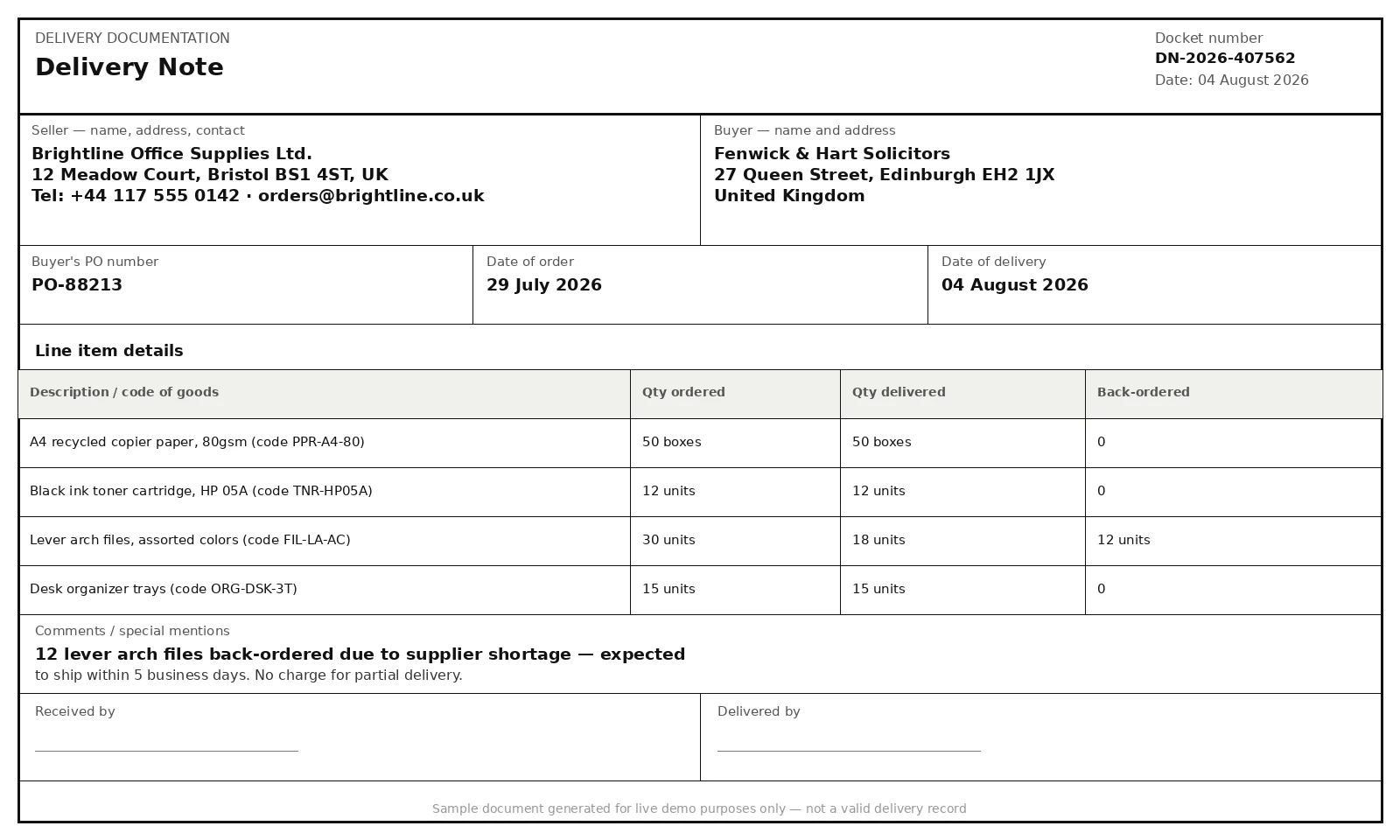
Select a document and press Parse
Want to run it on your own documents?
Ready to dive in? Request a key to get started.Business advantages
- Free to start, 1,000 credits per month on the Build plan
- Sub-second per-page processing for high-volume logistics workflows
- GDPR-compliant with end-to-end encryption and zero data retention options on Enterprise plans
- Works with any carrier or supplier format, no template training required
Frequently asked questions
What file formats does ByteIt support for delivery notes?
ByteIt accepts PDF, Word (DOCX), Excel (XLSX), and image formats including JPG and PNG. Delivery notes arrive in all of these, paper scans, mobile photos, emailed PDFs, and the engine handles them without format conversion.
Can ByteIt read low-quality scans or photos of delivery notes?
Yes. The AI vision models are designed for real-world document conditions: creased paper, low-resolution photographs, partial smudging, and faded photocopies. Confidence scoring flags uncertain fields so your team can verify only the edge cases instead of reviewing every document.
How do I integrate delivery note extraction into my systems?
ByteIt provides a REST API that returns structured JSON, CSV, or Excel data. You can also connect extracted data into your ERP or WMS using workflow automation tools such as n8n, Zapier, or Make. A Python SDK is available for direct integration.
Does ByteIt extract line-item tables from delivery notes?
Yes. The engine captures line-item data including SKU codes, item descriptions, quantity ordered, quantity delivered, unit of measure, and back-ordered goods, preserving the table structure so downstream systems can consume it without manual reconstruction.
What is the pricing for the delivery note extraction API?
ByteIt offers a free Build plan with 1,000 credits per month, a Scale plan at 260 € per month for 25,000 credits with parallel processing and team API keys, and custom Enterprise plans with flexible volumes, VPC or on-premise deployment, and dedicated support.
Does it handle multi-page delivery notes?
Yes. ByteIt processes multi-page documents and consolidates extracted fields across pages. This is useful when a delivery note runs to multiple sheets or when a POD form includes attached exception reports.
Related documents
Bill Of Lading
Extract structured data from bills of lading, shipper, consignee, container IDs, cargo details, and routing. Supports ocean, road, and multimodal BOL formats.
Custom Declarations
Extract structured data from customs declarations, SAD (C88), CN22, CN23, and other import/export forms. HS codes, declared values, parties, and line items from PDFs and scans.
Certificate Of Origin
Extract exporter, consignee, country of origin, transport route and goods data from certificates of origin. Automate customs clearance and trade compliance workflows.
Dangerous Goods Declarations
Extract structured data from Dangerous Goods Declarations (DGD). Capture UN numbers, hazard classes, shipping details, and emergency contact info from IATA and IMDG forms.
T1 T2 Documents
Extract structured data from EU T1 and T2 customs transit documents. Capture sender and recipient details, package counts, weights, seals, tariff numbers, and more.