
Benefits
Reduce customs delays by submitting correctly structured CoO data at the point of clearance, avoiding manual rekeying errors that trigger holds or inspections.
Eliminate manual data entry from paper or PDF CoOs, saving hours per shipment and freeing logistics staff for higher-value trade compliance work.
Improve trade agreement utilisation by ensuring origin declarations are accurate and complete, helping your organisation claim preferential duty rates with confidence.
Maintain an auditable, machine-readable record of every CoO processed, useful for post-clearance audits, trade compliance reviews, and retrospective duty analysis.
How it works
- Step 1
Upload
Send the document to the API as a file or a URL no special formatting required.
- Step 2
The engine reads the document
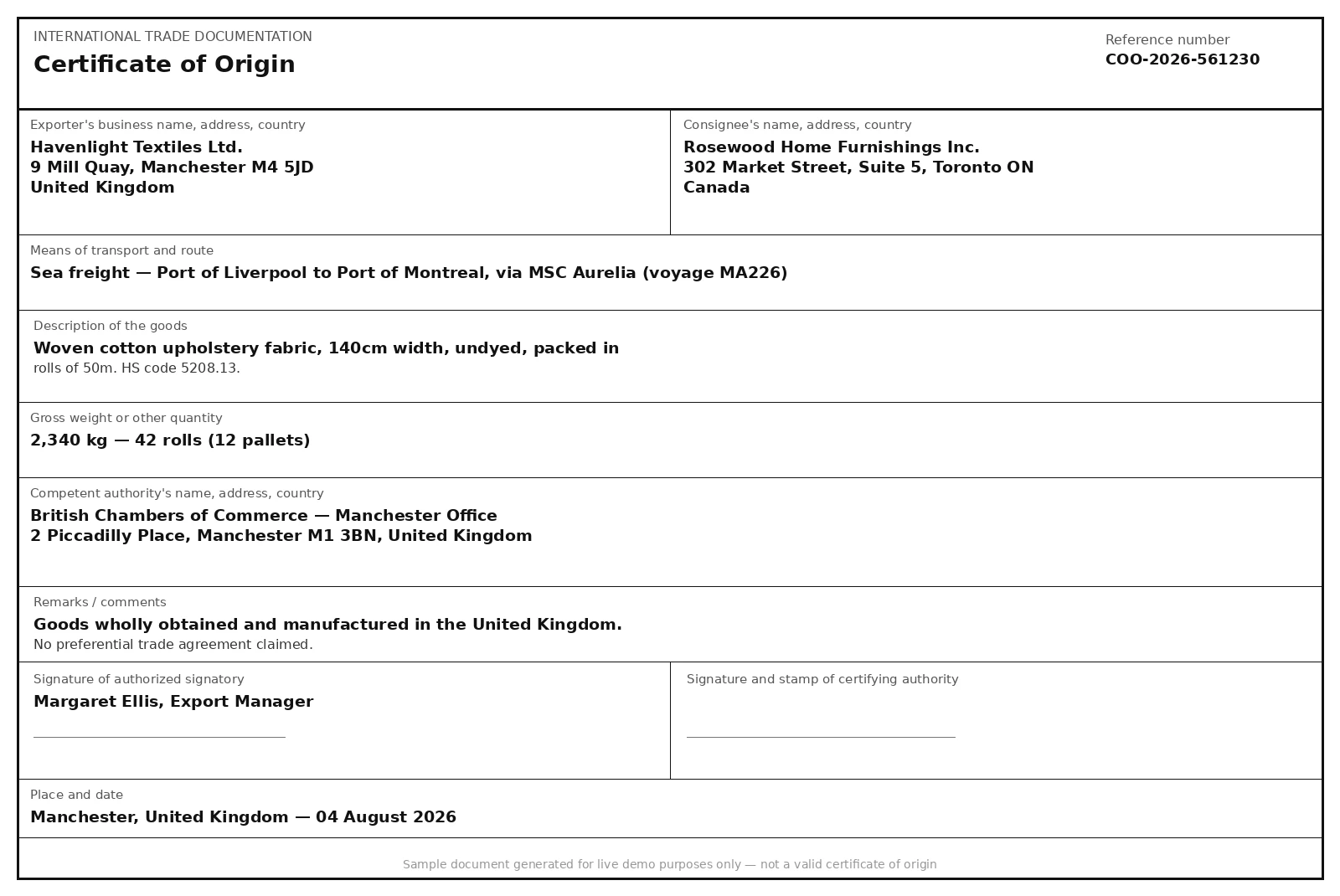
The engine analyzes the page layout and identifies the content that matters. The extraction engine reads the full Certificate of Origin layout, exporter and consignee blocks, transport and route section, goods table with descriptions and quantities, certifying authority details, signatures, stamps, and any remarks or special declarations, and returns each field in a structured JSON schema.
- Step 3
Structured JSON is returned
Every extracted element comes back as structured JSON, positioned and typed, ready to feed into downstream systems.
- Step 4
Confidence-based review
Each field carries a confidence score, so low-confidence results can be routed for human review instead of trusted blindly.
Extractable fields
Features
Extracts exporter name, address, and country; consignee name, address, and country; means of transport and route; goods descriptions, quantities, and gross weight.
Captures certifying authority details including name, address, country, signature, and stamp, plus authorised signatory signature, place, and date of issue.
Handles both preferential CoOs (used for free trade agreement claims) and non-preferential CoOs (used for general customs and statistical purposes) with the same extraction engine.
Processes PDF, JPG, PNG, TIFF, and multi-page documents without pre-sorting or manual page separation.
Returns structured JSON output that can be posted directly to ERP systems, customs filing platforms, or trade compliance databases via API or workflow automation tools.
Supports English-language documents out of the box with no additional training or configuration required.
Use cases
Automated Customs Filing
Extract CoO data and feed it directly into customs declaration platforms (e.g. CDS in the UK, ATLAS in Germany, ACE in the US) so that origin declarations are submitted with the correct country of origin, HS codes, and supporting references, reducing the risk of customs holds, penalties, or post-clearance audits due to misdeclared origin.
Trade Finance and Letter of Credit Compliance
When a letter of credit requires a Certificate of Origin as a presenting document, extract the certifying authority, reference number, and origin data automatically and attach it to the L/C compliance package. This ensures the CoO matches the documentary requirements before the bank reviews the presentation, reducing discrepancies that could delay payment.
Free Trade Agreement Preference Management
For importers and exporters claiming preferential duty rates under trade agreements such as the USMCA, EU-South Korea FTA, or CPTPP, extract the origin declaration, certifier details, and goods data from the CoO. Use the structured output to verify entitlement, archive origin evidence for the required retention period, and prepare for potential verification requests from customs authorities.
ERP and Trade Compliance System Integration
Connect extracted CoO data into your ERP (SAP, Oracle, Microsoft Dynamics) or trade compliance platform (e.g. Descartes, Thomson Reuters ONESOURCE) using workflow automation tools like n8n, Zapier, or Make. This eliminates manual double-entry and ensures that origin data flows from the shipping desk to the compliance team without rekeying.
Post-Clearance Audit and Duty Review
Build a searchable archive of every processed CoO with all extracted fields structured in a database. When a customs authority launches a post-clearance audit or origin verification, compliance teams can retrieve the original CoO data, the goods declaration, and the supporting transport documents in seconds rather than digging through paper files or scanned PDF folders.
LIVE DEMO
Try it yourself
Upload a sample Certificate of Origin in PDF, JPG, or PNG format to see the extracted fields returned as structured JSON in real time.
Select a document and press Parse
Want to run it on your own documents?
Ready to dive in? Request a key to get started.Business advantages
- GDPR-compliant and ISO 27001 certified, your trade document data stays encrypted and within the EU.
- Sub-second latency on most documents, enabling real-time customs and trade finance workflows.
- No training required, the engine extracts CoO data out of the box, across any layout or issuing authority.
- Pay-as-you-go pricing starting with a free Build plan (1,000 credits per month) and no long-term commitment.
Frequently asked questions
What file formats does the Certificate of Origin extraction support?
ByteIt accepts PDF, JPG, PNG, TIFF, Word (DOCX), and Excel (XLSX) files. Multi-page documents are handled automatically without requiring page separation.
Can it extract data from scanned or photos of paper CoOs?
Yes. ByteIt's engine processes scanned images and photos of printed Certificates of Origin. As long as the text is legible, the engine extracts the same fields it would from a digital PDF.
Does it handle both preferential and non-preferential Certificates of Origin?
Yes. The extraction engine reads all common CoO formats, including preferential certificates used for free trade agreement claims and non-preferential certificates used for general customs and statistical purposes. No configuration changes are needed between formats.
How do I integrate the Certificate of Origin extraction into my workflow?
ByteIt provides a REST API with a Python SDK. You can also connect the extraction output to ERP systems, customs filing platforms, or trade compliance tools using workflow automation tools such as n8n, Zapier, or Make.
Is the data from Certificates of Origin stored securely?
Yes. ByteIt is GDPR-compliant, ISO 27001 certified, and provides end-to-end encryption. Documents are stored encrypted for up to 7 days on the Scale plan (configurable on Enterprise) and are not used for model training without explicit consent.
What is the pricing for Certificate of Origin extraction?
ByteIt offers a free Build plan with 1,000 credits per month, a Scale plan at €260 per month for 25,000 credits with parallel processing and analytics, and a custom Enterprise plan with zero data retention, VPC or on-premise deployment, and dedicated support.
Can I extract line-item goods data from the goods table on a CoO?
Yes. The engine extracts the goods table including descriptions, HS codes, quantities, units, and gross weight per line item, plus totals such as total packages and total gross weight, all as structured JSON.
Related documents
Bill Of Lading
Extract structured data from bills of lading, shipper, consignee, container IDs, cargo details, and routing. Supports ocean, road, and multimodal BOL formats.
Custom Declarations
Extract structured data from customs declarations, SAD (C88), CN22, CN23, and other import/export forms. HS codes, declared values, parties, and line items from PDFs and scans.
Export License
Extract data from export licenses automatically. Capture ECCN codes, licence numbers, consignee details, and more with ByteIt's AI document extraction.
T1 T2 Documents
Extract structured data from EU T1 and T2 customs transit documents. Capture sender and recipient details, package counts, weights, seals, tariff numbers, and more.
Certificate Of Analysis
Extract structured data from Certificates of Analysis (COA) with ByteIt's AI engine. Capture batch numbers, test results, specifications and compliance details from PDFs and images.