
Benefits
Reduce turnaround time in customs and quality workflows by automating data capture from certificates of inspection
Eliminate manual data entry errors that cause shipment delays, compliance rejections, and costly re-inspections
Enable three-way matching between purchase orders, inspection results, and receiving records without manual data entry
Scale processing from a handful of certificates to thousands per month without adding headcount
How it works
- Step 1
Upload
Send the document to the API as a file or a URL no special formatting required.
- Step 2
The engine reads the document
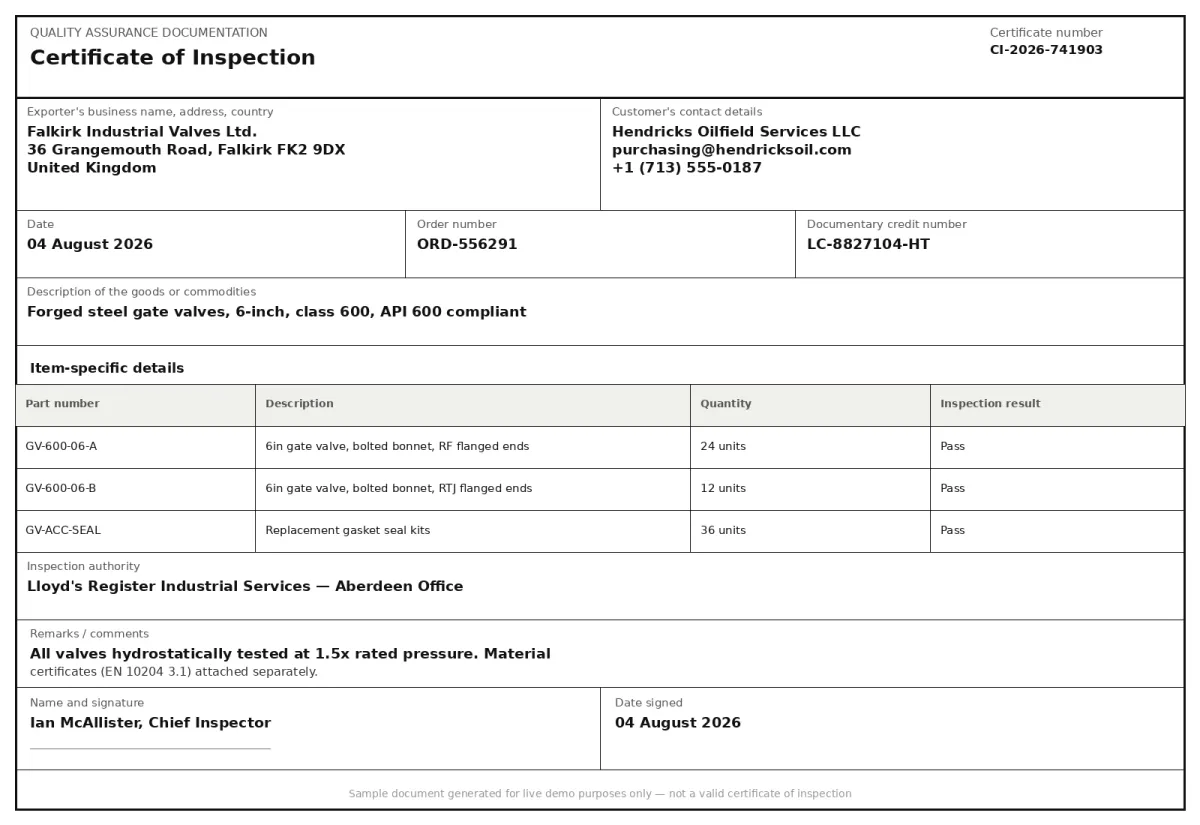
The engine analyzes the page layout and identifies the content that matters. ByteIt reads the full certificate of inspection, including header blocks, inspection result tables, product descriptions, and footer signatures, interpreting mixed layouts without template configuration.
- Step 3
Structured JSON is returned
Every extracted element comes back as structured JSON, positioned and typed, ready to feed into downstream systems.
- Step 4
Confidence-based review
Each field carries a confidence score, so low-confidence results can be routed for human review instead of trusted blindly.
Example fields
A sample of what extraction can return, and many more when they appear on the document.
Features
Extracts fields from common certificate of inspection layouts, including supplier-specific formats and multi-page documents, such as parties, goods, quantities, and many more.
Supports PDF, JPG, PNG, TIFF, Word, and Excel input files with no template setup required
Outputs data in structured JSON, CSV, XLSX, or XML via REST API or Python SDK
Processes documents in under two seconds per page with sub-second latency on standard files
Handles European languages out of the box, with best performance on English, French, German, Dutch, Spanish, Italian, and Nordic languages
End-to-end encryption and GDPR-compliant data handling for sensitive trade documentation
Use cases
Automated Customs Clearance
Forwarders and customs brokers receive hundreds of certificates of inspection daily. ByteIt extracts certificate numbers, inspection authorities, product descriptions, and quantities, then pushes structured data directly into customs declaration systems. This removes manual re-keying, reduces clearance delays, and flags missing or non-compliant certificates before submission — always verified by a human before filing.
Supplier Quality Assurance and Incoming Goods Inspection
Manufacturing and retail buyers must verify that each shipment matches the agreed quality standards. ByteIt extracts inspection results, defect classifications, sampling plans (e.g. AQL levels), and inspector credentials from supplier certificates. The structured data feeds into ERP quality modules and triggers automated pass/fail decisions, non-conformance reports, or supplier scorecards.
ERP and Workflow Automation Integration
Connect ByteIt's extraction output to your ERP, warehouse management system, or quality management platform using workflow automation tools such as n8n, Zapier, or Make. When a certificate of inspection arrives, the data flows automatically into purchase order matching, inventory receiving, or compliance dashboards without any manual data entry step.
Cross-Border Trade Compliance Reporting
Regulatory audits for imports of industrial equipment, food products, or chemicals require verified inspection documentation. ByteIt extracts documentary credit numbers, inspection authority seals, and remarks from certificates of inspection. The structured output powers compliance audit trails, regulatory filings, and on-demand reporting for customs authorities.
Multi-Site Certificate Reconciliation
Global logistics operations receive certificates of inspection from different suppliers and inspection agencies, each using a unique format. ByteIt normalises the data into a consistent schema across the common source layouts. This enables centralised dashboards that show inspection pass rates, outstanding certificates per shipment, and supplier compliance trends across all sites.
LIVE DEMO
Try it yourself
Upload a sample certificate of inspection in PDF, JPG, or PNG format and see ByteIt extract the key fields into structured JSON instantly.
Select a document and press Parse
Want to run it on your own documents?
Ready to dive in? Request a key to get started.Business advantages
- No template configuration: works with the common certificate layouts straight out of the box
- Sub-second processing per page, even for dense multi-page inspection reports
- GDPR-compliant with end-to-end encryption for sensitive trade data
- Free to start: test the API with your own documents, no credit card required
Frequently asked questions
What is a Certificate of Inspection?
A Certificate of Inspection (CoI) is an official document issued by an inspection agency or the exporter that confirms shipped goods have been examined and meet the specifications in the sales contract. It is commonly required for industrial equipment, meat, perishable goods, and regulated imports, particularly into developing countries.
How much does Certificate of Inspection OCR cost?
ByteIt uses simple, usage-based pricing with a free tier to get started and competitive per-page rates that typically cost just a few cents per page. Higher-volume and Enterprise plans add parallel processing, team API keys, zero data retention, or on-premise deployment. See the pricing page on byteit.ai for current plans and rates.
How do I integrate ByteIt into my workflow?
ByteIt provides a simple REST API and a Python SDK. You can also connect extraction results to downstream systems using workflow automation tools such as n8n, Zapier, or Make. Full documentation is available to get you started in minutes.
What languages does ByteIt support for certificates of inspection?
ByteIt supports English and most major European languages, performing best on certificates in English, French, German, Dutch, Spanish, Italian, Portuguese, Norwegian, Danish, Swedish, and Finnish. Additional languages can be supported on request.
What file formats can I upload?
ByteIt accepts PDF, JPG, JPEG, PNG, TIFF, Word (DOCX), and Excel (XLSX) files. You can upload single certificates or batch process multiple documents through the API.
How accurate is the extraction on certificates of inspection?
ByteIt uses context-aware AI models that read text, tables, and form fields within the certificate layout. Accuracy depends on the quality and clarity of the original document. For clean digital PDFs, extraction is highly reliable. Low-quality scans or handwritten annotations may reduce accuracy, though no template configuration is needed.
Can ByteIt handle multi-page certificates of inspection?
Yes. ByteIt processes multi-page documents natively. It reads across pages to capture fields that may be split, such as continuation of line items or remarks, and returns a single structured output for the entire certificate.
Related documents
Certificate Of Analysis
Extract structured data from Certificates of Analysis (COA) with ByteIt's AI engine. Capture batch numbers, test results, specifications and compliance details from PDFs and images.
Bill Of Lading
Extract structured data from bills of lading, shipper, consignee, container IDs, cargo details, and routing. Supports ocean, road, and multimodal BOL formats.
Custom Declarations
Extract structured data from customs declarations, SAD (C88), CN22, CN23, and other import/export forms. HS codes, declared values, parties, and line items from PDFs and scans.
Certificate Of Origin
Extract exporter, consignee, country of origin, transport route and goods data from certificates of origin. Automate customs clearance and trade compliance workflows.