
Benefits
Eliminate manual rekeying of shipper and consignee details, cargo weights, and packaging information from every FBL that crosses your desk.
Process multimodal transport documents in seconds instead of minutes, reducing customs clearance delays and demurrage risk.
Maintain consistent data quality across thousands of FBLs from different forwarders, carriers, and trade lanes without template configuration.
Connect extracted FBL data directly into downstream systems such as customs filing platforms, freight audit tools, and ERP modules.
How it works
- Step 1
Upload
Send the document to the API as a file or a URL no special formatting required.
- Step 2
The engine reads the document
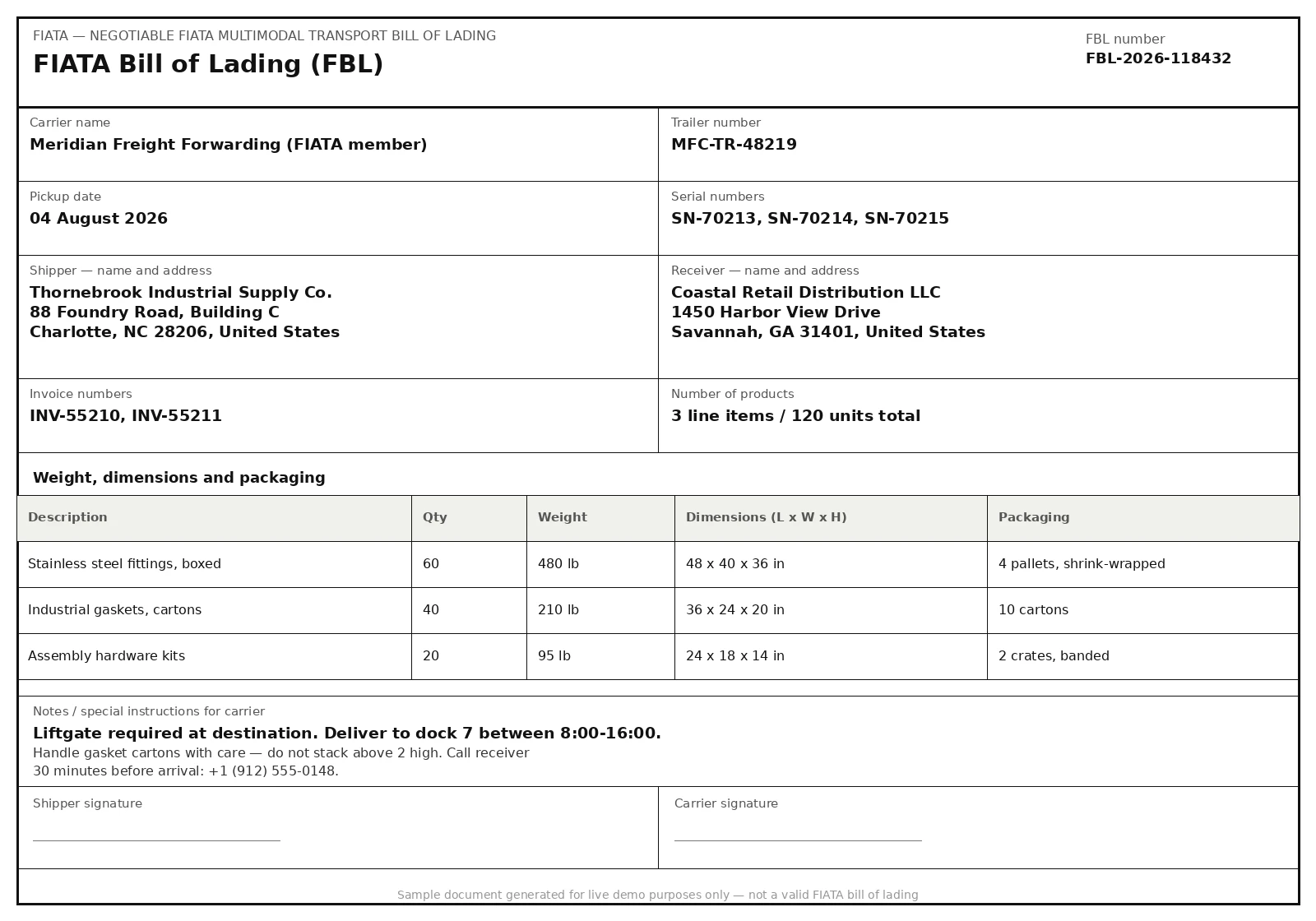
The engine analyzes the page layout and identifies the content that matters. The extraction engine reads and interprets the standard FIATA FBL layout, capturing fields from the document header, shipper and consignee address blocks, cargo description area, and packaging/weight summary tables regardless of variations in placement or formatting.
- Step 3
Structured JSON is returned
Every extracted element comes back as structured JSON, positioned and typed, ready to feed into downstream systems.
- Step 4
Confidence-based review
Each field carries a confidence score, so low-confidence results can be routed for human review instead of trusted blindly.
Extractable fields
Features
Universal parsing of FIATA Bills of Lading in PDF, JPG, PNG, Word, and Excel formats, no templates or training required.
Context-aware extraction of key fields including FBL number, carrier name, shipper and receiver addresses, serial numbers, and cargo dimensions.
Handles handwritten annotations, stamps, and varied document layouts common on paper and scanned FBLs.
Returns structured JSON or Markdown output via simple REST API, ready for integration with workflow automation tools.
Sub-second per-page processing with orchestrated precision that dynamically selects the optimal extraction engine for each document.
Use cases
Freight Forwarder Document Processing
Freight forwarders handling hundreds of FIATA Bills of Lading daily can automate the extraction of shipment identifiers, party details, and cargo descriptions. The structured output feeds directly into internal shipment tracking systems and customer portals, reducing admin overhead and improving response times to client queries.
Customs Clearance and Compliance
Customs brokers and compliance teams use extracted FBL data, including shipper name, receiver address, product weights, and packaging details, to pre-fill customs declaration forms and check documents against regulatory requirements before submission. This reduces hold-ups at border clearance and ensures data consistency across the declaration package.
Trade Finance and Letter of Credit Matching
Banks and trade finance departments process FIATA Bills of Lading as supporting documents for letters of credit. Extracted fields such as the FBL number, shipment dates, cargo quantities, and party names can be compared automatically against LC terms to flag discrepancies before disbursement.
ERP and TMS Integration via Workflow Automation
Extracted FBL data can be connected to your ERP or TMS using workflow automation tools such as n8n, Zapier, or Make. Shipment details, carrier information, and cargo dimensions flow automatically into purchase order matching, freight cost allocation, and inventory update processes without manual intervention.
Supply Chain Visibility and Analytics
Logistics analytics teams import structured FBL data from multiple trade lanes into dashboards and BI tools. Aggregating pickup dates, carrier performance, cargo weights, and route data across thousands of shipments enables trend analysis, carrier scorecards, and more accurate delivery forecasting.
LIVE DEMO
Try it yourself
Upload a sample FIATA Bill of Lading in PDF, JPG, or PNG format to see how ByteIt extracts FBL number, carrier details, shipper and receiver information, cargo weights, and packaging data in real time.
Select a document and press Parse
Want to run it on your own documents?
Ready to dive in? Request a key to get started.Business advantages
- Free Build plan with 1,000 monthly credits to start extracting FBL data immediately.
- End-to-end encryption and GDPR compliance, your shipment data stays secure and private.
- Scale plan at €260/month offers parallel processing and team API keys for logistics teams.
- Enterprise options with VPC or on-premise deployment for zero data retention requirements.
Frequently asked questions
How is a FIATA Bill of Lading different from a standard Bill of Lading?
A FIATA Bill of Lading (FBL) is a multimodal transport document issued by a FIATA-member freight forwarder, not by a shipping line. It covers transport across multiple modes, sea, air, road, or rail, under a single document and is negotiable, meaning ownership of the goods can be transferred while in transit. The FBL is recognised under UNCTAD/ICC Rules and commonly accepted for letters of credit.
What file formats do you support for FBL extraction?
ByteIt accepts PDF, JPG, JPEG, PNG, DOC, DOCX, XLSX, HEIC, and WEBP. Upload scanned paper FBLs or native digital files; the engine handles both without pre-processing.
Can the engine handle low-quality scans or handwritten annotations on FIATA Bills of Lading?
Yes. The extraction engine is trained on varied document quality, including scanned copies with faded text, stamps, and handwritten amendments commonly found on paper FBLs passed between multiple parties in the supply chain.
How do I integrate ByteIt's FBL extraction into my existing systems?
ByteIt provides a simple REST API and a Python SDK. Extracted data is returned as structured JSON, which you can forward to your TMS, ERP, customs platform, or internal database. You can also orchestrate the workflow using automation tools like n8n, Zapier, or Make without writing custom integration code.
Does the engine support multi-page FIATA Bills of Lading?
Yes. Multi-page FBLs are processed page by page with context maintained across the document. The engine consolidates extracted fields into a single structured output, even when fields span across pages.
What is the pricing for FBL document extraction?
ByteIt offers a free Build plan with 1,000 credits per month. The Scale plan costs €260 per month for 25,000 credits and includes parallel processing and team API keys. Enterprise plans with custom pricing are available for higher volumes and dedicated support.
What is the typical accuracy for FIATA Bill of Lading extraction?
ByteIt achieves high extraction accuracy through its context-aware AI engine and orchestrated precision that selects the best extraction method per document. Accuracy varies by document quality and layout variation, but the model is designed to handle the wide variety of FBL formats and forwarder-specific layouts without training.
Related documents
Bill Of Lading
Extract structured data from bills of lading, shipper, consignee, container IDs, cargo details, and routing. Supports ocean, road, and multimodal BOL formats.
Custom Declarations
Extract structured data from customs declarations, SAD (C88), CN22, CN23, and other import/export forms. HS codes, declared values, parties, and line items from PDFs and scans.
Delivery Notes
Extract delivery dates, item quantities, recipient details, and proof of delivery signatures from any delivery note or POD. No templates, no manual entry.
Shipping Labels
Extract tracking numbers, addresses, sender and receiver names, and package details from any shipping label, FedEx, UPS, DHL, USPS, and regional carriers. No templates needed.