
Benefits
Reduce customs clearance delays by making phytosanitary data immediately available for inspection authorities and downstream systems.
Eliminate manual rekeying of consignment details, treatment records, and NPPO stamps across multiple trade platforms.
Maintain audit-ready records with structured extraction that maps every field to its original document context.
Scale from dozens of certificates per week to thousands per day without adding headcount.
How it works
- Step 1
Upload
Send the document to the API as a file or a URL no special formatting required.
- Step 2
The engine reads the document
The engine analyzes the page layout and identifies the content that matters. ByteIt's extraction engine reads phytosanitary certificates across varied national formats, identifying and extracting certificate metadata, party details, botanical and commodity descriptions, treatment and inspection records, and official declarations regardless of layout differences.
- Step 3
Structured JSON is returned
Every extracted element comes back as structured JSON, positioned and typed, ready to feed into downstream systems.
- Step 4
Confidence-based review
Each field carries a confidence score, so low-confidence results can be routed for human review instead of trusted blindly.
Extractable fields
Features
Handles PDF, JPG, PNG, TIFF, and Word document formats with sub-second per-page processing.
Free-tier Build plan offers 1,000 credits per month; Scale plan at €260/month provides 25,000 credits with parallel processing and team API keys.
Python SDK and REST API with custom extraction schemas, define exactly which phytosanitary fields to capture.
End-to-end encryption and GDPR compliance for sensitive trade data.
Use cases
Automated customs clearance and border compliance
Forward phytosanitary certificate data directly to customs brokers, port authorities, or agricultural inspection agencies as structured JSON. Eliminate manual data entry for each certificate and reduce the risk of discrepancies that trigger holds at the border.
ERP and supply chain system integration
Feed extracted certificate details, including product descriptions, HS codes, quantities, and treatment methods, into your ERP, warehouse management, or trade compliance platform using workflow automation tools like n8n, Zapier, or Make. Keep procurement and logistics teams aligned on shipment status without shared spreadsheets.
Audit trail and regulatory record keeping
Store structured extraction results alongside original certificates in a searchable archive. When auditors or importing authorities request proof of treatment or origin, retrieve the relevant data in seconds instead of digging through paper files or scanned PDF folders.
Multi-party shipment coordination
Share structured phytosanitary data with freight forwarders, consignees, and insurance providers automatically. Each party receives only the fields relevant to their workflow, for example, treatment details for the insurer, consignment data for the logistics provider, without manual reformatting.
LIVE DEMO
Try phytosanitary extraction yourself
Upload a sample phytosanitary certificate (PDF, JPG, or PNG) or use our demo document to see the extracted fields in real time.
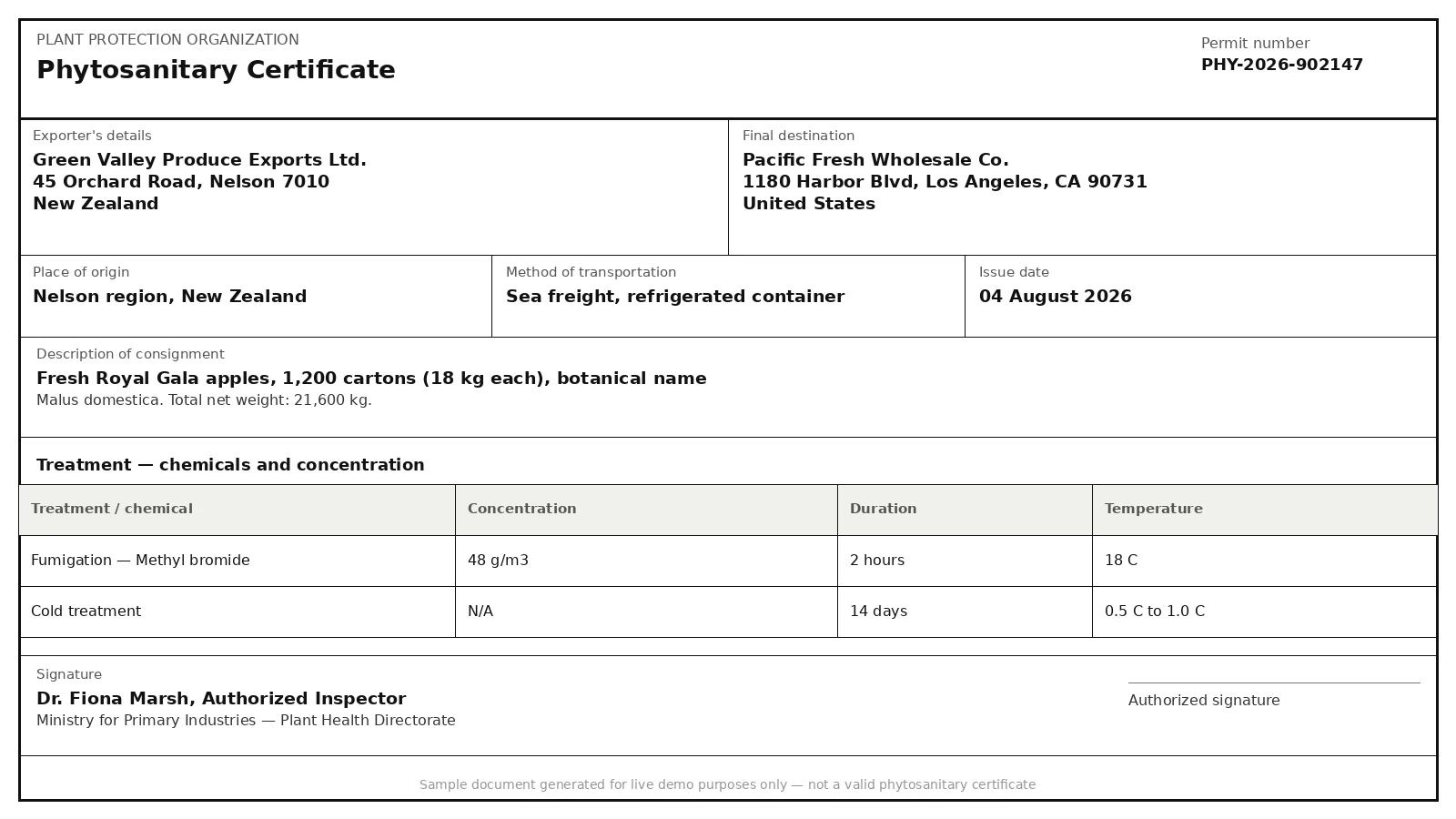
Select a document and press Parse
Want to run it on your own documents?
Ready to dive in? Request a key to get started.Business advantages
- Parse any national phytosanitary certificate layout without template configuration.
- No per-document training required, works out of the box for standard IPPC-format certificates.
- End-to-end encrypted data handling with GDPR compliance built in.
- Free tier available to evaluate before committing to a paid plan.
Frequently asked questions
What file formats are supported for phytosanitary certificates?
ByteIt accepts PDF, Word (DOCX), PowerPoint (PPTX), HTML, Markdown, plain text, JSON, XML, and common image formats including PNG, JPEG, TIFF, and BMP.
How do I integrate the phytosanitary certificate extraction into my workflow?
Use the Python SDK or direct REST API endpoints. You define a custom extraction schema specifying which fields to capture, such as certificate number, exporter details, or treatment method, and receive structured JSON output. Workflow automation tools like n8n, Zapier, or Make can connect the output to your ERP, CRM, or customs platform.
What does the API cost?
ByteIt offers a free Build plan with 1,000 credits per month, a Scale plan at €260/month for 25,000 credits with parallel processing and team API keys, and custom Enterprise pricing with flexible credit volumes, zero data retention, and SLAs.
Can it handle low-quality scans or photocopies of certificates?
Yes. ByteIt's engine is built to extract data from imperfect source documents, including scanned copies with skewed alignment, faded text, or variable contrast. The orchestration layer routes each document to the optimal extraction method for its quality level.
How accurate is the extraction for phytosanitary certificates?
ByteIt's extraction platform achieves 2.6x the precision of GPT-5 on document extraction benchmarks. Accuracy naturally varies with source quality and format complexity, but the engine is designed to handle the heterogeneous layouts of phytosanitary certificates across different issuing countries without template configuration.
Can I extract line-item details for multiple commodities on one certificate?
Yes. The engine reads item-level consignment data including botanical name, common name, HS code, quantity, unit of measure, packaging type, and number of packages. These are returned as structured arrays in the JSON output, ready for downstream processing.
Does ByteIt support multi-page phytosanitary certificates?
Yes. The platform processes multi-page documents and returns page-level metadata alongside the extracted fields. High-throughput workflows can use asynchronous extraction jobs to handle batches of certificates without blocking.
Related documents
T1 T2 Documents
Extract structured data from EU T1 and T2 customs transit documents. Capture sender and recipient details, package counts, weights, seals, tariff numbers, and more.
Bill Of Lading
Extract structured data from bills of lading, shipper, consignee, container IDs, cargo details, and routing. Supports ocean, road, and multimodal BOL formats.
Custom Declarations
Extract structured data from customs declarations, SAD (C88), CN22, CN23, and other import/export forms. HS codes, declared values, parties, and line items from PDFs and scans.
Export License
Extract data from export licenses automatically. Capture ECCN codes, licence numbers, consignee details, and more with ByteIt's AI document extraction.
Certificate Of Origin
Extract exporter, consignee, country of origin, transport route and goods data from certificates of origin. Automate customs clearance and trade compliance workflows.