
Benefits
Cut manual data entry from rail freight documents, reducing processing time from minutes per waybill to seconds
Eliminate transcription errors in consignee names, commodity codes, and freight charges that cause billing disputes and customs delays
Keep logistics operations running at pace by processing scanned waybills, digital PDFs, and multi-page consignment notes in a single API call
Scale rail freight processing without adding headcount, handling peaks in waybill volume during trade corridor surges
How it works
- Step 1
Upload
Send the document to the API as a file or a URL no special formatting required.
- Step 2
The engine reads the document
The engine analyzes the page layout and identifies the content that matters. The extraction engine reads and interprets railway bills and waybills of any layout, identifying consignor and consignee blocks, station names, routing and tracking sections, freight charge tables, and goods description fields across single and multi-page documents.
- Step 3
Structured JSON is returned
Every extracted element comes back as structured JSON, positioned and typed, ready to feed into downstream systems.
- Step 4
Confidence-based review
Each field carries a confidence score, so low-confidence results can be routed for human review instead of trusted blindly.
Extractable fields
Features
Extracts all critical fields including shipper and consignee information, origin and destination stations, routing instructions, tracking numbers, freight charges, and billing details
Handles scanned and digital railway bills in PDF, JPG, and PNG formats with optimised OCR for varied print quality and layout density
Processes multi-page consignment notes and waybill sets, maintaining field association across pages
Returns structured JSON output with each field clearly labelled, ready for integration into freight management systems, ERP platforms, or custom logistics dashboards
Dynamically selects the optimal extraction model for each document based on layout type, language mix, and document complexity
Use cases
Automated Freight Audit and Payment Reconciliation
Extract freight charges, billing information, and consignee details from railway bills and feed them directly into freight audit systems. Match extracted charges against contracted rates, flag discrepancies automatically, and reconcile payments without manual cross-referencing of paper waybills.
Cross-Border Customs Clearance Acceleration
Use extracted consignor, consignee, commodity, weight, and routing data to pre-fill customs declaration forms for rail shipments crossing EU, Eurasian, and ASEAN borders. Reduce clearance delays at border crossings by providing structured data to customs brokers and digital customs platforms ahead of train arrival.
Real-Time Shipment Tracking and Visibility
Parse tracking information, routing instructions, and transportation details from waybills to feed visibility platforms and customer portals. Enable logistics teams and end customers to track rail freight status without needing access to the original document.
Integration with Freight Management and ERP Systems
Connect extracted railway bill data into downstream logistics software, accounting platforms, or ERPs using workflow automation tools like n8n, Zapier, or Make. Automate the flow from waybill receipt to invoice generation, inventory update, or carrier payment without manual data re-entry.
Volume Processing for Freight Forwarders and 3PLs
Process hundreds or thousands of railway bills and consignment notes per day through ByteIt's API, handling mixed batches from different rail carriers and formats. Freight forwarders and third-party logistics providers can centralise waybill data capture across their entire rail freight portfolio.
LIVE DEMO
Try railway bill extraction yourself
Upload a sample railway bill or waybill in PDF, JPG, or PNG to see the extracted fields in real time.
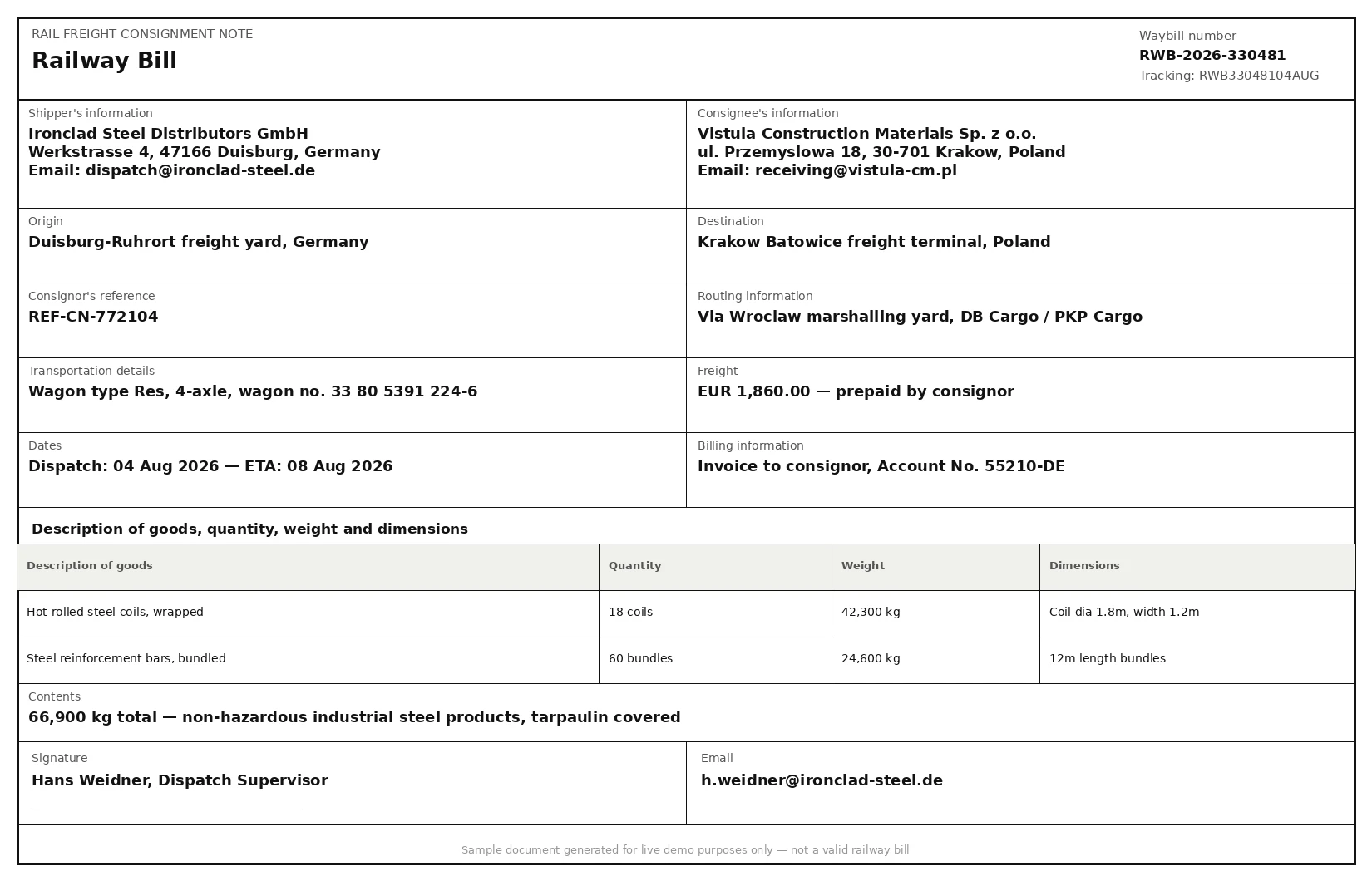
Select a document and press Parse
Want to run it on your own documents?
Ready to dive in? Request a key to get started.Business advantages
- No document templates or training required
- Sub-second processing per page
- GDPR-compliant with ISO/IEC 27001 certification
- Pay-as-you-go pricing starting at €0 for 1,000 credits
Frequently asked questions
What formats of railway bills does ByteIt support?
ByteIt accepts PDF, JPG, and PNG files. The engine handles scanned images of paper waybills, digitally generated PDF consignment notes, and multi-page document sets. There is no file size limit that requires manual splitting, although larger files may take slightly longer to process.
How do I integrate the railway bill extraction API?
ByteIt provides a simple REST API. Send your railway bill document via POST request and receive structured JSON output. A Python SDK is available for local development. You can also connect ByteIt to your logistics workflows through no-code automation tools such as n8n, Zapier, or Make.
What is the pricing for processing railway bills?
ByteIt offers a free Build plan with 1,000 API credits per month. The Scale plan costs €260 per month for 25,000 credits. Enterprise plans with flexible credit allocations, zero data retention, and dedicated support are available for high-volume rail freight operations.
Can it handle CIM and SMGS consignment note formats?
Yes. ByteIt's extraction engine handles railway bills and consignment notes across different formats and standards, including CIM (used across Europe) and SMGS (used across Russia, CIS states, and China). The model dynamically adapts to the document layout without requiring format-specific templates.
Does the API support multi-page railway bills?
Yes. ByteIt processes multi-page documents and maintains field association across pages. A single waybill set with multiple sheets is handled as one document, with all extracted fields returned in a unified JSON output.
How accurate is the extraction for poor-quality scans of railway bills?
ByteIt uses optimised OCR that performs well on scanned documents with varied print quality, dense layout tables, and low-contrast printing common in older carbon-copy waybills. The engine selects the best extraction model dynamically for each document to maximise accuracy.
Can I extract line-item details like commodity descriptions and quantities?
Yes. ByteIt extracts description of goods, quantity, weight, and dimensions from the goods line items section of railway bills. These fields are returned as structured data, making them ready for customs declarations, inventory tracking, and freight audit workflows.
Related documents
Bill Of Lading
Extract structured data from bills of lading, shipper, consignee, container IDs, cargo details, and routing. Supports ocean, road, and multimodal BOL formats.
Delivery Notes
Extract delivery dates, item quantities, recipient details, and proof of delivery signatures from any delivery note or POD. No templates, no manual entry.
Dispatch Notes
Extract dispatch notes, packing slips, and delivery confirmations into structured JSON. Automate goods-receipt matching and carrier reconciliation with AI.
Shipping Labels
Extract tracking numbers, addresses, sender and receiver names, and package details from any shipping label, FedEx, UPS, DHL, USPS, and regional carriers. No templates needed.