
Benefits
Eliminate manual data entry from VAT statements, reducing the risk of transposition errors in your return
Accelerate period-end close by digitising VAT data in seconds rather than minutes per document
Standardise VAT data across jurisdictions with a consistent output schema that feeds any accounting or tax-filing system
Build an auditable trail: every extracted value retains a link to its source location in the original document
How it works
- Step 1
Upload
Send the document to the API as a file or a URL no special formatting required.
- Step 2
The engine reads the document
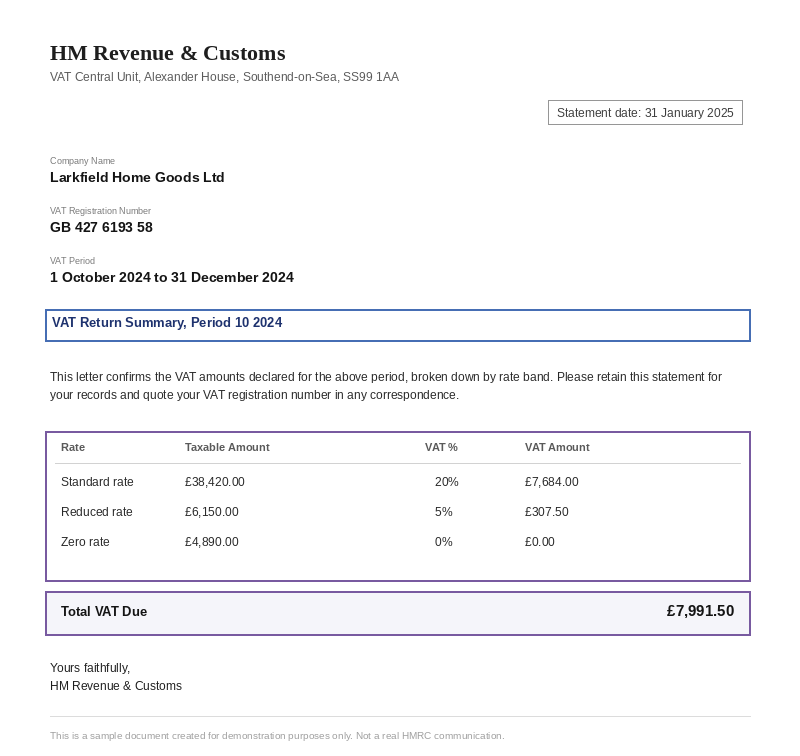
The engine analyzes the page layout and identifies the content that matters. ByteIt's extraction engine reads the header, summary tables, and rate-band breakdowns on a VAT statement, identifying key-value pairs and table structures to capture the tax authority, company details, VAT number, period, and all monetary fields including taxable amounts split by VAT rate.
- Step 3
Structured JSON is returned
Every extracted element comes back as structured JSON, positioned and typed, ready to feed into downstream systems.
- Step 4
Confidence-based review
Each field carries a confidence score, so low-confidence results can be routed for human review instead of trusted blindly.
Extractable fields
Features
Extracts tax authority, company name, VAT number, VAT period, statement date, taxable amounts, VAT amounts, VAT percentages, and total VAT amount
Handles both digital PDFs and scanned images of VAT statements, including documents with complex layouts or mixed rate bands
Returns data in clean JSON via a simple REST API, compatible with any programming language or workflow tool
Per-document credit model with no minimum commitment: start with the free Build tier (1,000 credits per month) and scale up as needed
Works with VAT statements from multiple jurisdictions without requiring template configuration per country
Use cases
Automated VAT return preparation
Extract the total output VAT, input VAT, and net balance from your VAT statement and feed them directly into your tax-filing software or working paper spreadsheet. Eliminate the copy-paste step that introduces keying errors ahead of each submission deadline.
Multi-entity consolidation for finance teams
Finance teams managing VAT for multiple subsidiaries can collect VAT statements from every entity, extract the figures in parallel, and consolidate them into a single group-level return or dashboard. The structured output makes it straightforward to aggregate VAT balances across legal entities.
VAT reconciliation and audit support
Compare the extracted VAT totals from your statements against the corresponding totals in your ERP or accounting ledger. Flag discrepancies immediately rather than discovering them during a tax audit. The structured data also serves as machine-readable audit evidence.
Connect VAT data to downstream systems via workflow automation
Pipe the extracted JSON from your VAT statement into accounting platforms, ERP systems, or custom databases using workflow automation tools such as n8n, Zapier, or Make. Trigger the extraction automatically whenever a new statement is uploaded to a cloud folder or email inbox.
VAT data extraction at scale for tax advisory firms
Tax advisory practices that handle VAT returns for dozens or hundreds of clients can process all incoming VAT statements through a single API pipeline. The consistent output schema allows batch analysis, anomaly detection, and preparation of consolidated reports without manual per-client handling.
LIVE DEMO
Try it yourself
Upload a VAT statement or choose a sample below to see ByteIt extract tax authority, VAT number, period, and amounts in real time. Accepts PDF, JPG, and PNG files.
Select a document and press Parse
Want to run it on your own documents?
Ready to dive in? Request a key to get started.Business advantages
- Free tier included: 1,000 credits per month at no cost
- No template configuration per country or tax authority
- Simple REST API with JSON output: integrate in hours, not weeks
- Sub-second processing for most standard VAT statement PDFs
Frequently asked questions
What does ByteIt's VAT statement extraction cost?
ByteIt uses a credit-based pricing model. The Build plan costs 0¢ per month and includes 1,000 credits. Extra credits cost 1.5¢ each. The Scale plan costs 260€ per month and includes 25,000 credits with extra credits at 1.1¢ each. Most standard VAT statement PDFs consume 1 credit per page. Complex layouts or scanned images may consume 2 credits per page.
How do I integrate the VAT statement extraction API?
ByteIt provides a simple REST API. Send a POST request with your document file, and receive structured JSON back. You can call it directly from your application code using the provided SDKs, or connect it to no-code workflow tools such as n8n, Zapier, or Make for automated pipelines.
What file formats are supported for VAT statements?
ByteIt accepts PDF, JPG, JPEG, PNG, DOC, DOCX, XLSX, HEIC, WEBP, and more. Both digital PDFs and scanned or photographed documents are supported.
How does the engine handle poor-quality scans or distorted VAT statements?
ByteIt's extraction engine uses advanced vision-language models that work well with scanned documents, including those with low resolution, skewed angles, or faint text. The system automatically detects complexity and applies more processing power when needed. Complex documents are charged at 2 credits per page rather than the standard 1 credit.
Does the extraction work with VAT statements from different countries?
Yes. The engine reads VAT statements regardless of the issuing tax authority or country-specific layout. It extracts the core fields that appear on most VAT statements, such as the VAT number, period, taxable amounts, and total VAT. The same output schema works across jurisdictions, making it suitable for multi-country tax operations.
Can I handle multi-page VAT statements?
Yes. ByteIt processes multi-page documents page by page. Credits are consumed per page (1 credit for a standard page, 2 for a complex page). The JSON output includes page-level metadata so you can track which data came from which page.
How accurate is the VAT statement data extraction?
ByteIt returns a confidence score for every extracted field. For clean digital PDFs with standard layouts, accuracy is consistently high. For heavily distorted scans or unusual layouts, we recommend a manual review of low-confidence fields. The confidence indicators in the output make it easy to prioritise which values need human verification.
Related documents
Invoice
Extract invoice number, vendor data, line items, VAT, and totals from PDF invoices, scanned invoices, and receipt images with ByteIt's invoice data extraction API.
Receipt
Extract merchant name, line items, totals, VAT, and payment method from receipts with ByteIt's AI receipt parser. No templates, no training – just structured JSON from any receipt format.
Bank Statement
Extract account holder, IBAN, transaction dates, debit/credit amounts, and balances from PDF and scanned bank statements with ByteIT's OCR API.
Credit Card Statement
Extract transactions, balances, and payment details from any credit card statement with AI. Parse Visa, MasterCard, Amex and more into structured JSON.
Remittance Advice
Extract payment details, invoice references, and customer data from remittance advices automatically. Speed up accounts receivable reconciliation with AI.