
Benefits
Reduce claims cycle time by eliminating manual data entry from handwritten and checkbox-heavy accident forms
Cut transcription errors that cause downstream disputes, rework, and settlement delays
Handle cross-border EAS variants without custom templates for each language or jurisdiction
Process high volumes during peak accident periods without scaling headcount
How it works
- Step 1
Upload
Send the document to the API as a file or a URL no special formatting required.
- Step 2
The engine reads the document
The engine analyzes the page layout and identifies the content that matters. The extraction engine reads European Accident Statement forms regardless of language variant, handwriting quality, or layout skew, locating and transcribing driver contact details, vehicle registration and insurance info, the date/time/location of the accident, damage descriptions, and signatures.
- Step 3
Structured JSON is returned
Every extracted element comes back as structured JSON, positioned and typed, ready to feed into downstream systems.
- Step 4
Confidence-based review
Each field carries a confidence score, so low-confidence results can be routed for human review instead of trusted blindly.
Extractable fields
Features
Reads handwritten text, typed entries, and checkbox selections from photographed or scanned EAS forms
Extracts structured data including driver details, vehicle information, insurance data, and accident circumstances
Supports all EU language variants of the Constat Amiable / EAS form without per-country configuration
Delivers output as structured JSON for direct ingestion into claims, policy, and case management systems
Accepts input in PDF, JPG, JPEG, and PNG formats via API or web upload
Use cases
Automated motor claims intake
Insurers receive EAS forms from policyholders or repair shops. ByteIt extracts all fields and feeds the structured data into the claims management system, triggering FNOL creation and reserve calculation without manual keying.
Cross-border claims processing in the EU
A pan-European insurer processes EAS forms in French, German, Spanish, Italian, and Polish variants. The extraction engine handles each language variant without template switching, passing normalised data to a central claims hub.
TPA bulk processing for fleet insurers
Third-party administrators process hundreds of accident statements per week for fleet insurance clients. ByteIt's batch API extracts data from all forms in a single job, reducing per-document handling time from 20+ minutes to seconds.
CRM and workflow automation
Extracted EAS data can be routed into customer relationship or workflow platforms using automation tools such as n8n, Zapier, or Make, enabling automated follow-up tasks, claimant communication, and document status tracking.
Fraud detection and underwriting analytics
Structured accident data from EAS forms is fed into fraud scoring models or underwriting dashboards, giving risk teams a consistent data set for pattern analysis and loss forecasting.
LIVE DEMO
Try European Accident Statement extraction live
Upload a sample EAS form (PDF, JPG, or PNG) to see how ByteIt extracts driver details, vehicle info, and accident data in real time.
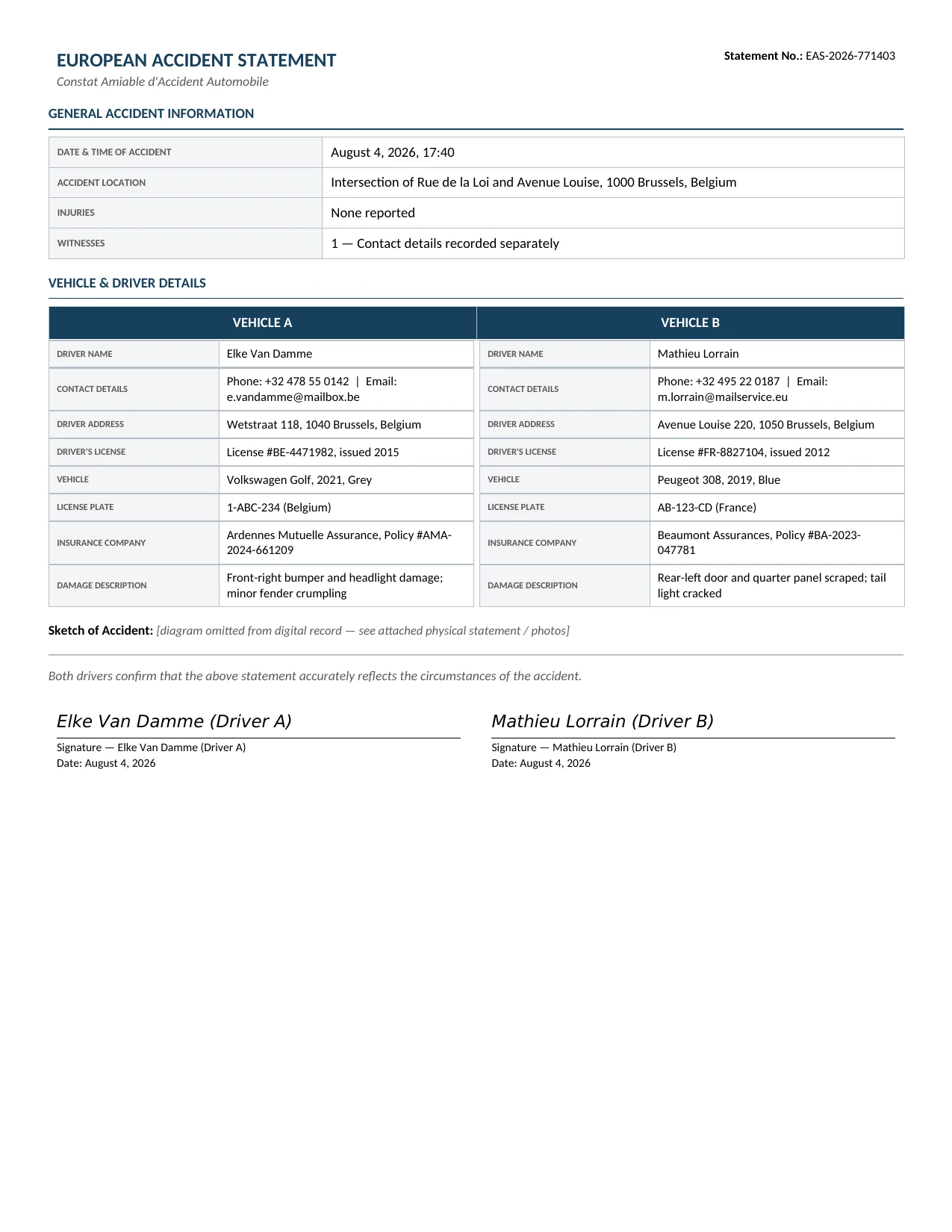
Select a document and press Parse
Want to run it on your own documents?
Ready to automate your claims intake? Request a key to get started.Business advantages
- Works on photographed forms from mobile phones, no scanner needed
- No per-language or per-country template setup required
- ISO 27001 certified data processing
- Pay-as-you-go API pricing with no minimum commitment
Frequently asked questions
How much does European Accident Statement extraction cost?
ByteIt uses a pay-as-you-go credit model. Each extracted page consumes a set number of credits. Detailed pricing is available on the pricing page; there is no minimum monthly commitment or setup fee.
How do I integrate EAS extraction into my claims system?
ByteIt exposes a REST API that accepts base64-encoded files or URLs. SDKs are available for Python, Node.js, Go, and other languages. Data can also be routed via workflow automation tools like n8n, Zapier, or Make.
What language variants of the European Accident Statement does the engine support?
The engine supports all EU language variants of the Constat Amiable / EAS, including English, French, German, Spanish, Italian, Dutch, Polish, Portuguese, and others, without requiring per-language configuration.
What file formats are accepted?
ByteIt accepts PDF, JPG, JPEG, and PNG files. Scanned, photographed, and digitally generated documents are all supported.
How does the engine handle low-quality scans or photographs of accident statements?
The extraction engine is trained on real-world inputs including crumpled, shadowed, and low-resolution photos of EAS forms. It pre-processes the image to enhance legibility before extracting text and checkboxes.
Can it extract handwritten text and checkbox selections?
Yes. The engine reads printed and handwritten entries as well as checked/unchecked boxes found on standard EAS forms, covering driver details, accident circumstances, and the accident sketch notes.
Does the engine support multi-page EAS forms?
Yes, multi-page forms are processed as a single document, and all fields across pages are consolidated into one structured JSON output.
Related documents
Insurance Claims
Extract structured data from insurance claim forms and supporting documents automatically. Claimant details, policy numbers, loss descriptions and more in seconds.
Travel Insurance Claims
Extract claimant name, policy number, incident details and more from travel insurance claims with AI-powered OCR. Speed up claims processing and reduce manual data entry.
Proof Of Residence
Extract structured data from proof of residence documents. AI-driven OCR reads utility bills, bank statements, lease agreements and more for KYC compliance.
Death Certificate
Extract structured data from US death certificates with AI-powered OCR. Capture decedent details, cause of death, certifying physician info, and more.
Land Registry
Extract property, owner, and transaction data from land registry documents using AI-powered OCR. Automate title verification, compliance checks, and deed processing.