
Benefits
Reduce manual data entry time from minutes per report to seconds, cutting processing costs for every loan application.
Improve underwriting accuracy by feeding verified, structured property data directly into your loan origination system.
Eliminate rekeying errors on appraised value, comparable sales, and legal descriptions that can delay mortgage approvals.
Scale appraisal processing volume without adding headcount, handling spikes during peak lending seasons effortlessly.
How it works
- Step 1
Upload
Send the document to the API as a file or a URL no special formatting required.
- Step 2
The engine reads the document
The engine analyzes the page layout and identifies the content that matters. The extraction engine reads and interprets the Uniform Residential Appraisal Report (URAR) structure, including Section 1 property data, comparable sales tables, valuation approaches, and appraiser certifications, handling both typed and handwritten entries.
- Step 3
Structured JSON is returned
Every extracted element comes back as structured JSON, positioned and typed, ready to feed into downstream systems.
- Step 4
Confidence-based review
Each field carries a confidence score, so low-confidence results can be routed for human review instead of trusted blindly.
Extractable fields
Features
Extracts all key fields from Section 1 (Subject) of URAR and similar appraisal forms: property address, borrower, legal description, parcel number.
Captures valuation data including appraised value (sales comparison approach, cost approach) and comparable sales with addresses, sale prices, and adjustments.
Reads property characteristics such as year built, gross living area, lot size, bedroom/bathroom counts, garage spaces, and condition/quality ratings.
Handles multi-page appraisal documents, consolidating repeated file numbers and extracting data from continuation sheets and addenda.
Supports both printed and handwritten field entries common in appraisal reports, with robust OCR tuned for real estate documentation.
Use cases
Mortgage Origination, Automated Data Import into LOS
When a loan officer receives a completed URAR or similar appraisal report, the extraction engine reads every field, from the appraised value and comparable sales to the property's legal description, and outputs structured JSON. That data flows directly into the loan origination system, removing manual rekeying and the errors that come with it.
Portfolio Valuation and Risk Modelling
Asset managers and risk analysts processing quarterly portfolio valuations can batch-upload hundreds of appraisal reports. The engine extracts appraised value, cost approach, sales comparison approach, and comparable sale data, feeding into valuation models and risk dashboards for near-real-time portfolio health monitoring.
Compliance and Audit Workflow Automation
Compliance teams reviewing appraisal reports for regulatory adherence (e.g. USPAP) can automate the data collection step. Extracted fields such as appraiser credentials, effective date, neighbourhood rating, and market conditions are logged and compared against policy rules, flagging reports that need manual review.
Secondary Market and Investor QA
Investors purchasing pools of mortgage loans require validated appraisal data for due diligence. The extraction engine pulls property attributes and appraised values from each report, enabling systematic quality assurance checks against investor guidelines before closing.
Integration with Workflow Automation Tools
Connect the extracted appraisal data to your existing stack using workflow automation tools like n8n, Zapier, or Make. Route structured data into Salesforce, Tableau, or custom databases without writing integration code, enabling end-to-end process automation from appraisal receipt to loan decision.
LIVE DEMO
Try it yourself
Upload a sample appraisal report (PDF, JPG, or PNG) or use our pre-loaded example to see structured extraction in action.
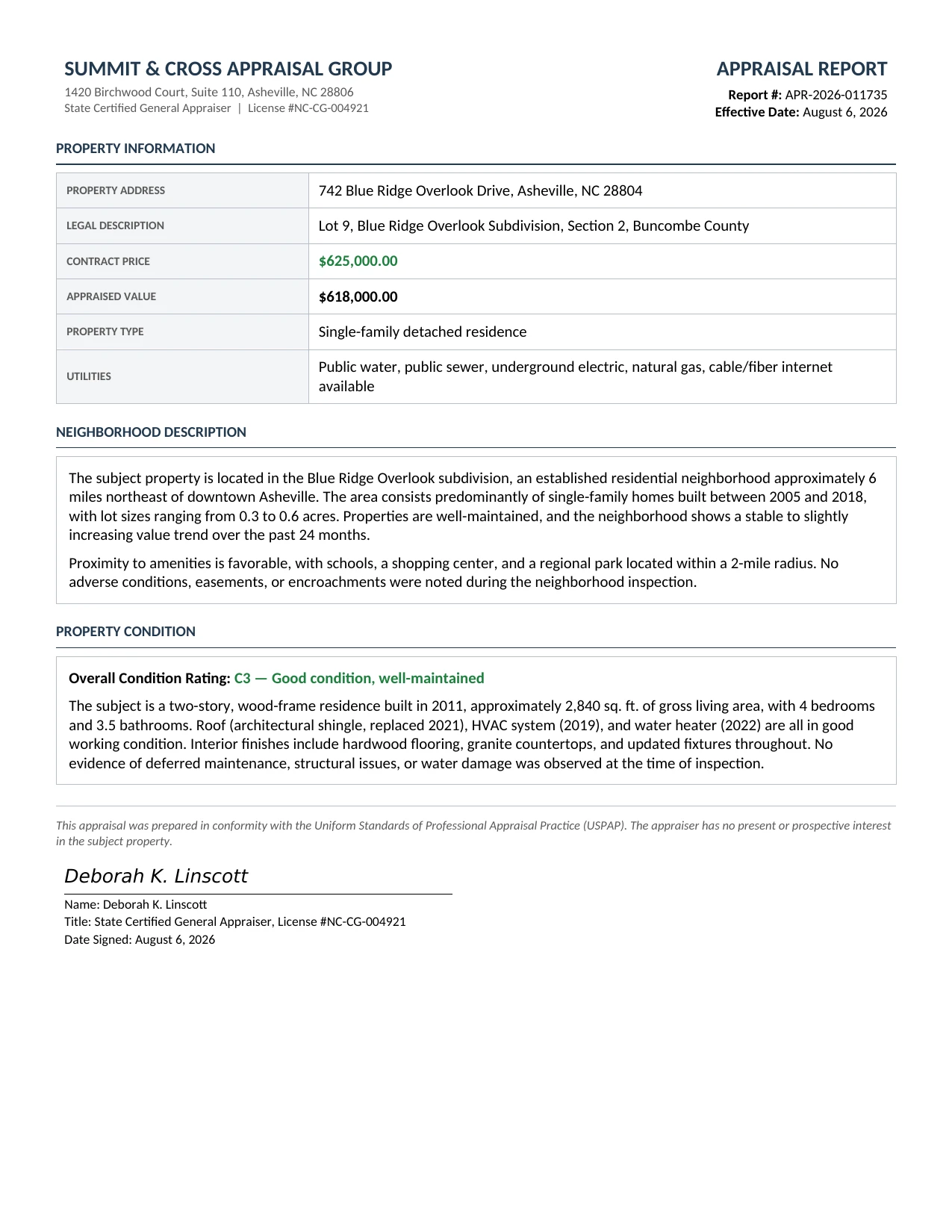
Select a document and press Parse
Want to run it on your own documents?
Ready to dive in? Request a key to get started.Business advantages
- Process thousands of appraisal reports per day with a single API endpoint.
- Eliminate back-office headcount needed for manual data entry from scanned forms.
- Shorten mortgage approval cycles by hours per application with instant data extraction.
- Reduce compliance risk by ensuring every field on the appraisal is captured and auditable.
Frequently asked questions
How does the pricing work for appraisal report extraction?
ByteIt operates on a credit-based pricing model. Each page of an appraisal report consumes a fixed number of credits. You can find the latest per-page credit cost and available plans on the ByteIt pricing page. High-volume plans offer reduced per-credit rates.
Can I integrate the extraction API with my loan origination system?
Yes. ByteIt provides a REST API that returns structured JSON. You can connect it to your systems directly via the API, or use no-code workflow tools like n8n, Zapier, or Make to pipe data into your LOS, CRM, or database without custom code.
Does the engine support both Fannie Mae 1004 and other appraisal formats?
The extraction engine is trained on the Uniform Residential Appraisal Report (URAR) / Fannie Mae 1004 / Freddie Mac 70 structure, as well as other common US appraisal formats. It reads both printed and handwritten entries on these forms.
What file formats are supported for appraisal report uploads?
The API accepts PDF, JPG, and PNG files. Multi-page PDFs are fully supported, and the engine processes all pages, including continuation sheets and addenda, in a single call.
How does the engine handle low-quality scans or handwritten appraiser notes?
The OCR engine is built for real-world document quality and can handle scanned forms with faded text, handwritten entries, stamps, and varying contrast. For documents that fall below a confidence threshold, the API returns partial results with the extracted content it can read reliably.
Does the extraction handle multi-page appraisal documents?
Yes. Appraisal reports commonly span multiple pages, including the main form, continuation sheets, comparable sales grids, property photos, and addenda. The engine processes all pages and consolidates extracted data, including repeated fields like file number.
Related documents
Contracts
Extract parties, contract clauses, signatures, and applicable law from legal contracts using ByteIt's structured data extraction API. Supports PDFs and scanned documents.
Rental Agreements
Extract tenant details, rent amounts, escalation schedules, and key clauses from residential and commercial rental agreements. AI-powered OCR for any lease format.
Permits
Extract structured data from building permits, environmental permits, and regulatory licences with AI. Capture dates, signees, clauses, risk keywords, and more.
Flood Certificates
Extract flood zone, BFE, property details, and community data from flood certificates automatically. API for lenders, insurers, and floodplain managers.
Energy Certificates
Extract structured data from energy certificates with ByteIt's AI engine. Capture energy labels, consumption data, GHG ratings, and more from PDFs and images.